Shaping Hope: Fire Survivors Find Healing in Ceramics at the Armory Center
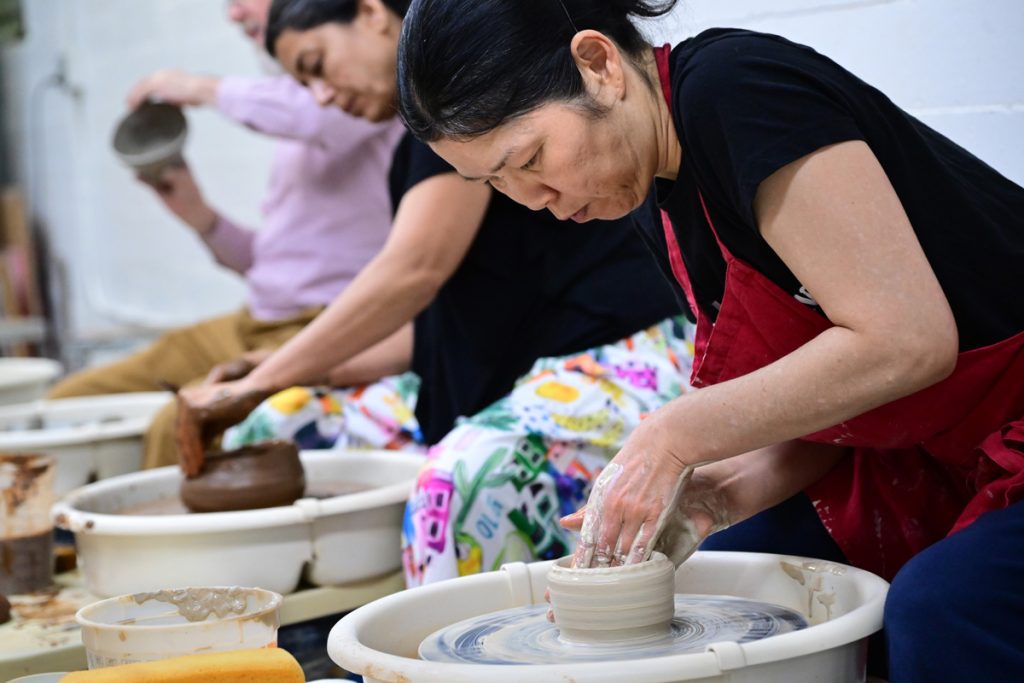
Healing began for Altadena resident Akiko Nishio not only with rebuilding her home, but also with putting her hands in clay at the Armory Center for the Arts.
After losing her home of seven years in the Eaton Fire, Nishio and her family were left with almost nothing – a few sets of clothes, a stuffed animal and one laptop.
Among the things Nishio missed most were the ceramics she had spent years collecting. “We lost all the plates and cups. I used to love collecting ceramics. We lost everything,” she said.
Her spirits began to shift when a friend who also lost her home told Nishio that the Armory was offering free art classes for wildfire survivors through a scholarship program.
“I always wanted to try ceramics,” Nishio said. “But I just put it away. I’m a busy mom and I work. But I thought this was the best opportunity for me to start as a beginner and I couldn’t afford it without the scholarship.”
Working with clay gave Nishio something she didn’t expect after such a loss: the chance to rebuild in a different way.
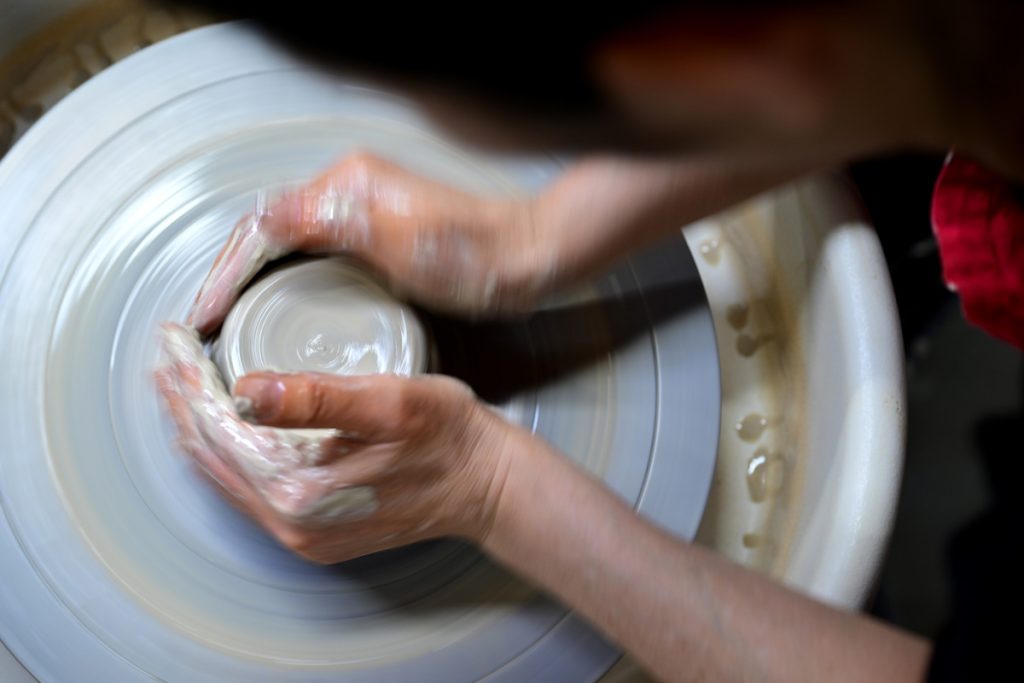
“Now we can recreate what we lost. And it’s with my own hands. I’m more excited to recreate it even though it doesn’t look perfect,” she said. “By taking these classes, I can transform the narrative from ‘I lost everything’ to ‘I can create something new.’”
Nishio is just one of more than 250 students who have taken classes through the Armory as part of this scholarship program, which is supported by a grant from the California Community Foundation (CCF).
Part museum and part art school, the Armory Center has been bringing artist-led classes to children, teens and adults in the Pasadena area since 1989. While it has existed in its current location on Raymond Avenue for more than 35 years, the Armory’s roots stretch back more than a century.
Being a local institution, the Armory naturally sprung into action after the Eaton Fire, making aid to survivors one of its primary goals. With the support of CCF, the Armory staff quickly began mounting a series of essential creative care programs.
This included transforming a meeting room into the Community Creativity and Care Room, which provides healthy snacks and drop-in arts activities for all-ages, also serving as a meeting space for organizations such as the Altagether Altadena Eaton Fire Survivor Support Group and the Soil Restoration Coalition.
The Armory also provided classroom space and studio access to the eight local schools severely impacted by the fire and hosted exhibitions featuring work created by wildfire survivors. When its Spring 2025 quarter began, the Armory created a full-studio scholarship program for wildfire survivors for its 10-week courses, and plan to continue through the end of 2027.
“Grants from the California Community Foundation have been pivotal in enabling the Armory to respond both immediately and over the long term to the needs of wildfire survivors,” said Andrew Gould, the Armory’s vice president of external relations. “By ensuring consistent access to artist-led programming and communal spaces, these grants have helped survivors regain a sense of agency, supported mental health and emotional processing, and rebuilt social connections in the aftermath of devastating loss.”
Gould explained the importance of these efforts, saying that “creative practice provides a non-verbal outlet for trauma, helps regulate stress, and restores a sense of control at a time when people’s lives have been profoundly disrupted. For many survivors, participating in artmaking classes or informal creative spaces offers stability and routine, while also creating opportunities for social connection outside the bureaucratic pressures of recovery.”
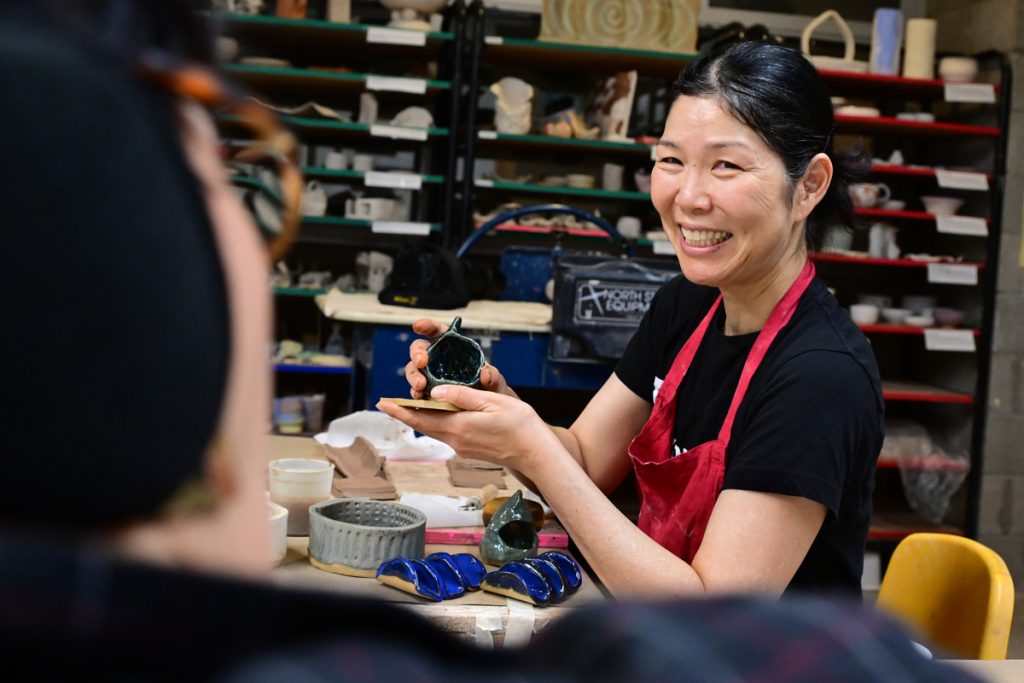
Nishio is living proof of Gould’s assertion. She reflected that “losing a home in a fire is more than losing a physical place to live. It’s losing your sense of safety, your memories and routines… Art can become a powerful way to heal from that kind of loss and create a sense of control.”
“The fire was sudden and uncontrollable, but when I make something, I can choose the color, I can choose the shape, I can choose the texture and I can make whatever I want to make. I feel like I’m in charge. I feel good. Through art, you can recreate memories.”
Nishio’s entire family has benefitted from the Armory. Their current living space is now full of ceramics that she has created, both decorative and practical. This includes bowls and cups for their kitchen and a candle holder she made for her mother-in-law. “My kids love to use my stuff,” she said, explaining how one of her daughters loves to do nails and recently asked to borrow one of her ceramic plates while experimenting with a look.
Nishio then smiled, recalling a pair of bowls that she created. “I’m still learning… it’s so hard to make more than one identical thing. But those two [look] similar. So, my husband and I can share, or the two kids can share. I like that.”
Akiko isn’t the only member of the Nishio family using the Armory’s classes to replace lost memories. Her younger daughter is taking painting classes and “she loves it.”
Nishio lamented that “We lost all [the kids’] art from school… that really hurt. I’d been collecting all their art and letters, and we can’t recreate those. But I’ve been telling them, hey, you can create more and share it with us. Now, she’s been coming home saying, ‘look what I made, look what I made!’ I’ve been collecting again.”
— Brennan Klein