A Mission to Serve: Charles Drew Medical Students Care for Neighbors With Neglected Health Needs
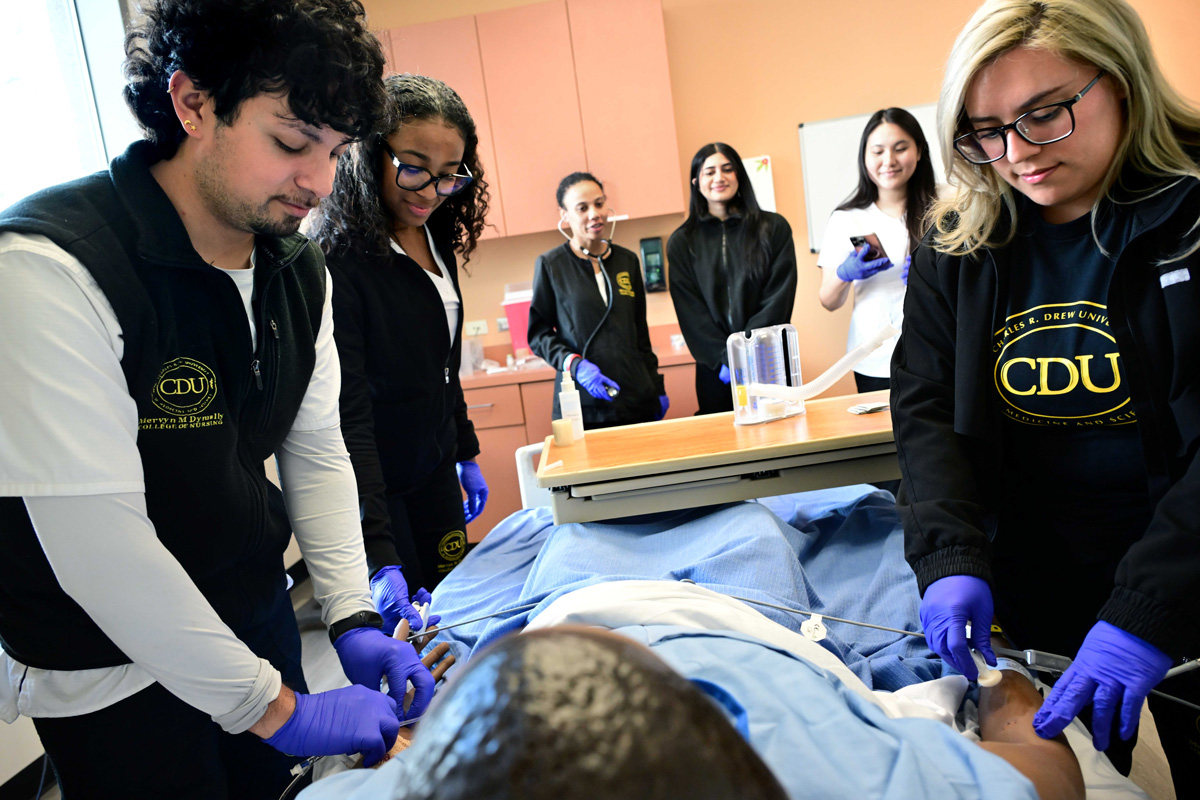
They grew up in low-income communities of color and powered their way through college, emerging with undergraduate science degrees from the University of California and other respected institutions.
Now Josh Vivas, Sierra Payne and Sharon Vivian are pursuing master’s degrees in nursing at the region’s most diverse medical university – Charles R. Drew University of Medicine and Science in Los Angeles – so they can return to the underserved communities they came from and help their neglected neighbors.
The three students reflect the university’s cherished mission as it celebrates its 60-year anniversary this year: to recruit, support and graduate medical professionals equipped with the skills and cultural knowledge to provide health care for the diverse communities of Los Angeles and beyond. CDU and its mission have long been supported through multiple grants from the California Community Foundation to help provide Angelenos with the education, jobs, health care and other essentials they need for a good life.
“Even though we are one of the most diverse populations in the country,” Vivas said of Los Angeles, “we are also one of the most segregated by class and by race. So the work that we do is just so important, and there’s no better campus than CDU to get an education that focuses on the underserved populations.”
CDU was founded in the aftermath of the 1965 Watts Uprising and is the only one of the nation’s four Historically Black medical colleges located in the Western United States. The university is located in South Los Angeles, one of eight geographic regions designated by the Los Angeles County Department of Health to serve as a specialized hub for public health, homeless services and mental health resources to address the area’s high rates of poverty, health disparities and housing insecurity.
The health care needs among the area’s 1 million residents are dire: a shortage of as many as 2,000 primary care doctors has left too many residents with untreated diabetes and other chronic diseases, said CDU President David M. Carlisle.
That, in turn, has led to drastic outcomes that could have been avoided with proper medical care – such as amputations of lower limbs due to diabetes, the No. 1 surgical procedure at the nearby Martin Luther King Jr. Community Hospital, Carlisle said. Strokes related to hypertension are another “epidemic in our community,” he said, adding that tooth extraction services widely touted in bus stop advertisements would not be needed with proper dental care.
“What we’re seeing is that we still have a disproportionate burden of chronic disease of all types,” Carlisle said. “It’s a very unfortunate situation that should not be occurring.”


But CDU is expanding to help meet the need with new medical programs and facilities. A new Health Professions Education Building is set to open this summer to house the four-year medical degree program, classrooms, anatomy laboratories and collaborative spaces. The medical degree program, launched in 2023 with support from CCF and other foundations, will produce its first class of 60 physicians in 2027. The joint medical degree program with UCLA, first started four decades ago, will be phased out, said Angela L. Minniefield, COO and senior vice president of advancement and operations.
CDU’s increased graduation of physicians and other medical professionals of color will help address the acute shortage of them – and improve health outcomes. One study found that greater representation of Black primary care physicians was associated with increased life expectancy and lower mortality among people who shared their racial background.
Minniefield, in recent remarks to CCF trustees and staff, expressed gratitude for other CCF grants over the years, including those to “rebirth” the physician’s assistant program and help the university acquire a 99-year ground lease from the Compton Unified School District that will allow the campus to double its 11-acre size with affordable student and community housing, a biomedical hub and a recreational field.
She said support from CCF is especially critical now as federal cuts have squeezed research funds, including those seeking to address health inequities and increase researchers from underrepresented communities. Proposed reductions in federal Pell grants – from about $500,000 to just under $150,000 – will make it harder to support the low-income students the university is trying to attract, she said.
“We don’t know if the threats will actually become a reality, but it’s enough to scare us into a situation where we’re constantly looking over our shoulder, wondering what’s going to hit us next,” Minniefield said.
The curriculum includes instruction on health disparities and racial, religious and cultural differences that help health care professionals provide informed and competent care. Students were recently taught, for instance, about physiological differences in how Black people tend to filter proteins through their kidneys, which could affect medication dosages.
The high-tech mannequins that students work on for clinical practice – which can be programmed to replicate breathing, temperature changes, even giving birth – reflect diverse races, genders and ages.
More than 80% of CDU’s 7,000+ graduates across its colleges of medicine, nursing, science and health provide care in underserved communities, according to university data.

The opportunity to serve their communities has been a primary draw for many of the CDU students. After earning her bachelor’s degree at Xavier University in Louisiana, Payne returned to CDU’s Watts-Willowbrook neighborhood specifically to give back to her lifelong community. She joined the CDU Saturday Science Academy in kindergarten, where she learned to use the blood pressure cuff and check temperatures. The academy exposed her to cadavers and dissections in middle school. The experience nurtured her interest in science, and built confidence that she could succeed in a health care career. She then began to serve as a mentor for the program.
“A lot of our [alumni] come back and serve, and that creates the cycle of mentorship and leadership,” she said.
Vivian, who earned her undergraduate degree in biology at UCLA, said she feels blessed to be able to study at CDU and volunteer at the many community programs. She recently helped out at a Black History Month cultural festival, providing education about diabetes, hypertension and strokes and feels rewarded to serve low-income, Spanish-speaking families who are similar to her own.
Other CDU attractions have been the supportive faculty and diverse student body – which is about 35% Black, 31% Latinx, 9% Asian and 6% white with some Native Hawaiian or Pacific Islanders and those of two or more races.
Vivas, for instance, said he felt isolated and alone at UC Irvine, where there were few students of color in the School of Biological Sciences. He also felt guilty that he was not enjoying the privilege of attending a top university – an elite education his immigrant parents were never able to access. At CDU, however, he felt embraced by both students and faculty.
“Every student feels they need to have a place,” he said, tearing up. “You are home here. You are family here.”
Shila Bui, another nursing student who was raised by an immigrant mother from Vietnam, said the university encouraged the students not to work so they could focus on studies and provided a scholarship to help them do that. Faculty also gave freely of their time when needed – including one professor who helped her learn efficient study habits and another who offered weekly four-hour Zoom tutoring sessions to make sure they were prepared for exams.
“Growing up in a low-income neighborhood, other people look at you and they think, ‘Oh, she’s nothing,’” said Bri Ana Valentine, also a nursing student. “But with funding and support, we become that kid who grows up, furthers our education and gives back to the community we came from to help change the world and save a life.”
– Teresa Watanabe

