“People will die.” State and Federal Budget Cuts Rip Apart Public Safety Net but CCF Vows to Respond
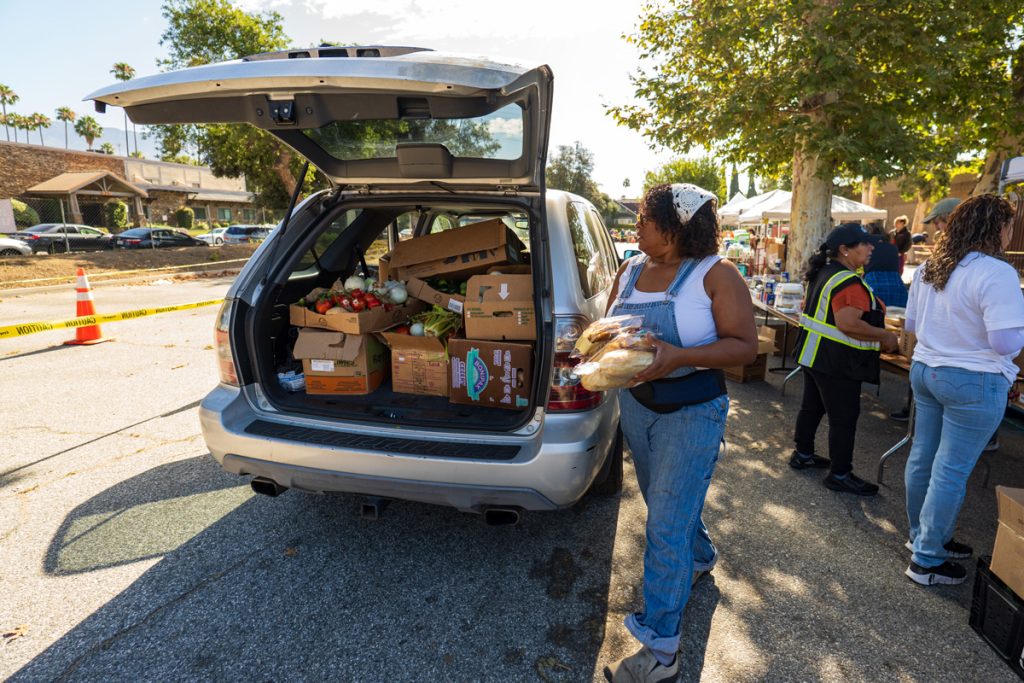
State and federal budget cuts and policy changes are wreaking “complete and absolute devastation” as they rip apart the public safety net and jeopardize the lives of hundreds of thousands of Angelenos.
That was the alarming message that city, county and community experts delivered to the California Community Foundation’s Board of Directors this month in a session on how state and federal actions are drastically reducing food assistance, health care and housing subsidies for struggling families across Los Angeles County. The presentation focused on the impact of the federal H.R.1, also known as the “One Big Beautiful Bill,” and cuts enacted in the 2025-26 California state budget to close a multibillion-dollar deficit.
“This is probably the most significant and the most devastating piece of legislation that hits social service programs in quite some time,” said LaShonda Diggs, assistant director of the Los Angeles County Department of Public Social Services (DPSS). “It’s going to take government, the community, philanthropy and others to really sit down and think through how we can implement this in a way that’s aligned and have the least amount of devastation to our families.”
The staggering impacts were laid out by Diggs; Lourdes Castro Ramírez, president and CEO of the Housing Authority of the City of Los Angeles; and Jim Mangia, president and CEO of St. John’s Community Health, a network of 28 community health centers and five mobile clinics.
The state and federal cuts would amount to a $3.7 billion hit over three years to the L.A. County Department of Health Services and Department of Public Health. Up to 1.1 million L.A. County residents would lose their Medi-Cal coverage by 2028.
Mangia said the state and federal cuts are delivering a “one-two punch” to the public safety net. He said 178,000 Angelenos already have lost their Medi-Cal coverage and 680,000 will lose access to dental coverage. Some community clinics will lose 80% of their funding.
His health care network is fielding as many as 500 phone calls a day from people wondering if they’ve lost their health coverage amid rampant confusion and fear, Mangia said.
“You’re talking about absolute and complete devastation,” Mangia said. “I think we have to recognize that we have a fundamental problem…that if we continue to make cuts, people will die.”
Additional burdens include new restrictions on health care for certain immigrants who previously had been eligible for coverage; work requirements to qualify for benefits; and increased paperwork to certify eligibility twice annually rather than once. Beginning in 2027, Medi-Cal recipients between 19 and 64 will have to spend at least 80 hours each month working, studying, volunteering or doing other approved activities. Veterans, unhoused individuals and former foster youth will no longer be exempt from work requirements. Parents with children under age 14, pregnant women, seniors older than 65, those with disabilities and certain others are exempt.
Diggs said about 60% of the 1.5 million Angelenos subject to the Medi-Cal work requirements – about 800,000 people – will need to find work, a training program, volunteer opportunities or other activities.
“It’s not realistic to think that hundreds of thousands of individuals [can] enter the workforce, so we have to think of ways to help our customers,” Diggs said.
About 210,000 Angelenos are losing food assistance under a 30% cut in the federal food assistance program known in California as CalFresh.
Castro Ramírez said about 2,800 families will lose emergency housing vouchers that had given them safe shelter from the streets, domestic violence and other precarious situations. That’s because the U.S. Department of Housing and Urban Development (HUD) is ending that program early, in December, rather than the original sunset date of September 30, 2030.
And more potential devastation is looming. HUD has proposed a rule that would eliminate federal housing subsidies to all “mixed status” households, or those that include U.S. citizens, legal immigrants and undocumented people. Under current rules, U.S. citizens and legal immigrants can receive benefits even if they live with those without papers. But the proposed rule could put 7,190 California households – and 800,000 people across the country – at risk of eviction or family separation, according to a motion passed in March by the L.A. County Board of Supervisors opposing HUD’s proposed rule.
Castro Ramírez said that many of those targeted by the cuts are wrongly perceived as not trying to get ahead on their own. Jeffrey, for instance, had worked for years to buy a condo and a boat but had a severe car accident that required multiple surgeries and a long recovery process. He lost everything, Casto Ramírez said, and ended up living in his car. He was able to receive an emergency housing voucher – but that assistance will end in December.
“Now he’s worried about what’s going to happen,” she said. “I think it’s important that we remember that behind all these numbers and data that there are real people that are really working hard to have a good life.
“We seem to have forgotten that we are a country that cares about its people, and strengthening our safety net is critically important,” she said.
Miguel A. Santana, CCF president and CEO, noted that many of the people losing food assistance are also losing health benefits and housing subsidies – and that creating myriad barriers to qualify for them is a deliberate effort to push people out of the safety net.
“Keep in mind that they are being triply and quadruply whacked,” he said. “We have to understand that what took place and what is taking place is a chopping away at the infrastructure by design. It’s really intended to create barriers so that you disappear, so you get off the rolls. Politically, it was harder to simply say, ‘We want to cut this program.’ So they basically designed it so it will end up that way.”
Santana said that philanthropy can’t replace the federal government in providing all essential services. But CCF is providing grants and emergency support for struggling Angelenos; stepping up advocacy; and building coalitions to craft a collaborative response among philanthropy, business, labor, faith and government. CCF is also providing some financing to help partners working to meet basic needs and inviting supporters to contribute to the foundation’s Impact Fund to support those in need.
DPSS has held webinars and created a website, Keep Your Benefits, to inform people about the changes and how to maintain eligibility for services. And L.A. County supervisors have placed a proposal on the June ballot to temporarily increase the sales tax by a half-cent – to 10.25% – to support health care services amid reductions in state and federal funding. The tax increase would raise $1 billion annually through Oct. 1, 2031.
CCF board members pledged continued support to step up for vulnerable neighbors with the message: We are all in this together.
– Teresa Watanabe