Donors Raised $1 Billion for Palisades and Eaton Fire Relief – but It’s Not Nearly Enough
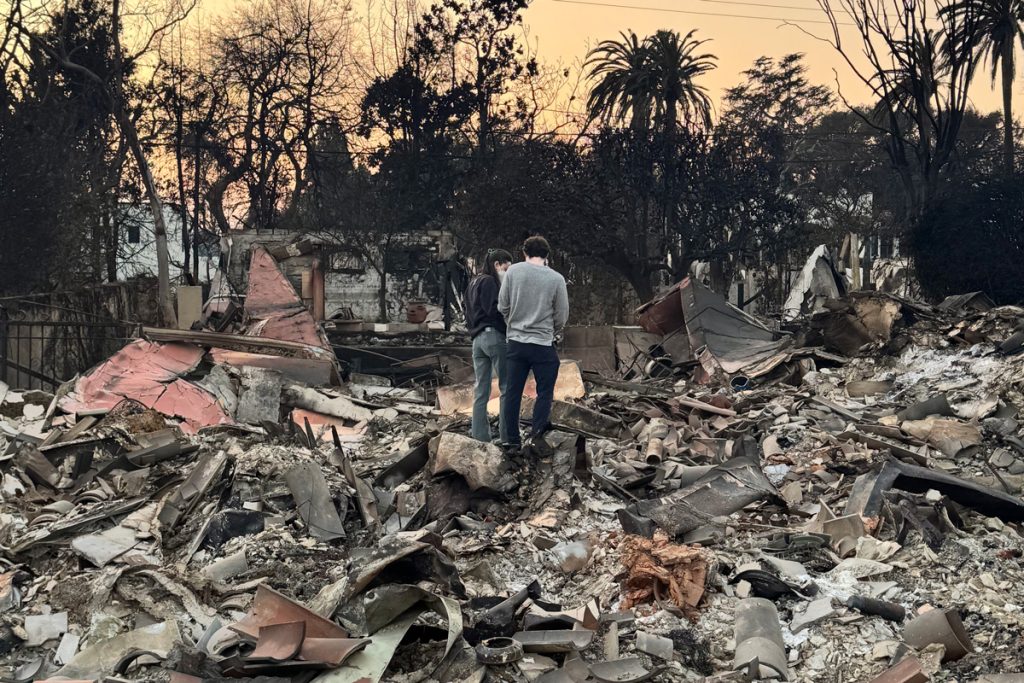
In a swift and extraordinary response to the horrific Palisades and Eaton fires last year, donors in Los Angeles and around the world committed nearly $1 billion to help survivors with immediate relief and longer-term rebuilding – an effort believed to be the largest ever mobilized for any U.S. natural disaster, according to a new report by the Milken Institute.
But as the first anniversary of the Jan. 7 fires approaches this week, the report notes that the charitable giving amounts to less than 2% of the estimated cost of rebuilding after the disaster killed 31 people, destroyed more than 16,000 structures and forced the evacuation of 100,000 residents. The Los Angeles Economic Development Corp. estimated that property losses ranged from $28 billion to $54 billion. UCLA Anderson School of Management put the property and capital losses between $76 billion and $131 billion, without accounting for insurance or settlement proceeds.
The gap between recovery resources raised and those needed has left survivors in the fire-hit areas of Altadena, Pasadena, Pacific Palisades and Malibu facing enormous pressures.
“Impressive as they are, charitable giving resources still pale in comparison to the cost of rebuilding,” the report said. “Private generosity cannot sustain a long-term rebuilding effort; renewed government support and new approaches to recovery finances are needed.”
The report, the first comprehensive analysis of philanthropy’s contributions to wildfire relief efforts and the road forward, was commissioned and funded by the California Community Foundation, Bank of America, Altadena Builds Back Fund, Pasadena Community Foundation, R & S Kayne Foundation, The Ralph M. Parsons Foundation, SoCal Fire Fund and The Walt Disney Company.
CCF President and CEO Miguel A. Santana said the rebuild cost gap in Los Angeles exceeds $50 billion – and the community needs at least $35 billion in additional sustained federal support for housing, infrastructure, environmental remediation, and long-term mental health care. The state of California has asked the federal government for that additional support but has yet to receive any.
“Philanthropy can move quickly and stay present — and we will continue to do that,” Santana said. “But philanthropy was never meant to replace government at this scale. Without that partnership, families remain stuck — not because they lack resilience, but because the system is underfunded.”
Despite the enormous need, the report notes that the federal administration began reducing its funding for disaster recovery last year, shifting the responsibility to state and local governments. After the Hurricane Katrina catastrophe in and around New Orleans in 2005, the Congressional Budget Office estimated that federal spending exceeded $110 billion in direct disaster outlays. After the L.A. fires, the Federal Emergency Management Agency, Small Business Administration and other agencies spent $5.7 billion to clear debris, provide assistance to survivors and offer recovery loans to homeowners and small business owners, the Milken report said.
“The potential retreat of the federal government raises the question of how the region will close the financial gap and how charitable giving can be a part of creative, new long-term approaches to bottom-up recovery and rebuilding,” the report said.
In addition, crowdfunding that soared after the wildfires exploded last year – GoFundMe alone raised $265 million – has ebbed. But survivors still need direct and flexible cash assistance, as expiration looms for temporary insurance payouts for rental assistance.
The report lays out how philanthropy – including corporations, foundations, individuals and others – raised and distributed funds for relief. It is based on data from 30 dedicated wildfire funds and more than 600 donor and receiving organizations, along with nearly 1,000 individual donor transactions.
CCF, for instance, raised more than $100 million last year, distributing $30 million in the first 30 days to survivors for food, clothing, housing support, mental health care, legal assistance and other needs through trusted partners. Overall, about 70% of the donations were directed to survivors for early, immediate relief and 25% went for that plus longer-range rebuilding efforts.
Recipients included established disaster relief organizations, such as the American Red Cross, trusted networks, community nonprofits and new groups – many started by survivors such as the Eaton Fire Survivors Network.
Collaborations played a key role in organizing the massive relief effort. The report highlighted, for instance, the Department of Angels, a nonprofit co-founded by CCF’s Santana and Evan Spiegel, CEO of the firm that owns Snapchat. The nonprofit empowers and mobilizes survivors as community leaders and lifts up their voices through a quarterly survey that tracks their continuing needs as they navigate the rebuilding journey.
The latest survey of more than 2,000 survivors found that seven of 10 remain displaced, more than 80% say their mental health has worsened and nearly half have depleted a significant portion of their savings.
Some new ventures are filling gaps left by the federal government’s reduction in services. The R&S Kayne Foundation funded CAP.LA, providing free soil testing and air quality monitoring by researchers from Loyola Marymount University, UCLA and Purdue University. Although FEMA conducted such tests after the 2018 Camp Fire, it has declined to do so after the Eaton and Palisades fires.
And new efforts are underway to help the rebuilding process. Bank of America, for instance, announced a commitment of $10 million in zero-interest loans to three community development financial institutions to acquire fire-affected property lots and redevelop them into affordable, fire-resistant homes.
Still, the report emphasized that the massive scope of needs dwarfs private efforts. “Charitable gap-filling is laudable and record-breaking in scale, yet it remains insufficient and unsustainable,” the report concluded.
Even so, CCF and the Department of Angels are committed to supporting survivors for the long term, until all who want to rebuild can do so, Santana said.
“Recovery is not a moment,” Santana said. “It’s a promise.”
– Teresa Watanabe