Pathway to Good Jobs in Underserved Communities Laid Out in CCF Summit

Just north of Los Angeles, on the western tip of the Mojave Desert, the Antelope Valley offers vast land, affordable housing and a relatively young and diverse population eager for quality work opportunities.
But more robust education and training are needed to fill the kinds of jobs the area produces in aerospace, construction, health care, manufacturing and other sectors.
That was a major message in a recent regional summit on how to build inclusive and sustained economic growth hosted by the California Community Foundation, Los Angeles County Economic Development Corp. and other partners in the Los Angeles County Jobs First Collaborative. The gathering brought together civic leaders, regional partners and recipients of state grants provided by the California Jobs First investment initiative, which provided $9 million for 26 innovative programs earlier this year.
The “Catalyst” grants, which provided seed money to kickstart development of projects that center underserved communities, reflect the state initiative’s efforts to promote equity and inclusion in economic planning, along with sustainability, access to quality jobs, competitiveness and resilience. The one-year funding covered projects across the county’s geographical regions, from Lancaster to Long Beach, and in seven key industries – aerospace, bioscience, construction, clean and renewable energy, health care, transportation and video production and distribution. Those sectors were identified as growth areas by the collaborative, a diverse group of more than 700 community members which hosted the summit.
The regional summit at Antelope Valley College, the sponsor, provided an opportunity to network, swap information, celebrate progress and identify challenges in the California Jobs First effort.
“This initiative cannot just be a moment. It must be a movement. Across Los Angeles County, we are seeing a shift of movement towards solutions that are locally rooted, regionally coordinated and driven by the people who know their communities best, and that’s all of you in this room.”
— Cielo Castro, CCF chief impact officer
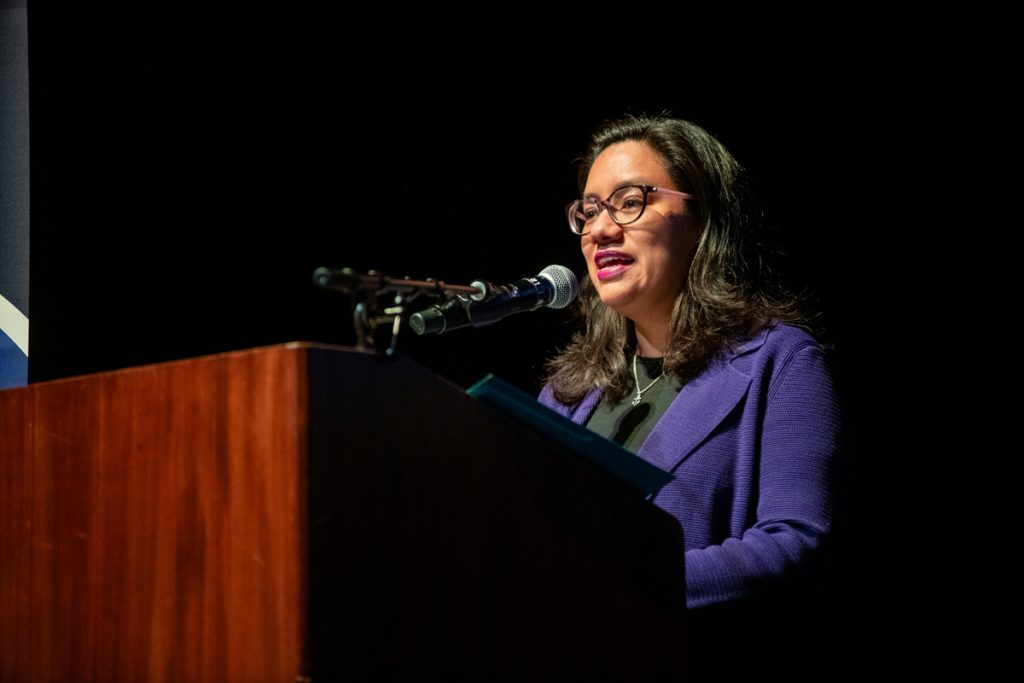
“This initiative cannot just be a moment. It must be a movement,” Cielo Castro, CCF chief impact officer, said in remarks at the opening session. “Across Los Angeles County, we are seeing a shift of movement towards solutions that are locally rooted, regionally coordinated and driven by the people who know their communities best, and that’s all of you in this room.”
Castro emphasized the need to center equity and collaboration in creating good-paying jobs for community members. Economic opportunity doesn’t begin with a job offer, she said, but long before that with access to education, training, mentorship, networks and trust “that the systems we’re building will serve everyone, not just the few.”
Stephen Cheung, CEO of the county’s economic development corporation, pledged a continued focus on collaboration over competition and broad inclusion of all community voices “to make sure that every corner of this county sees itself in the economic future that we’re building together.”
The summit featured a fireside chat with leaders who helped win a $24 million state grant for four bioscience projects in L.A. County this year. The fast-growing industry combines biology and technology to develop vaccines, new medical drugs and devices, sustainable agriculture, renewable energy and many other applications.
The grants will help recipients survey the county’s existing resources for bioscience growth, develop career pathways, support new startups and help those ready to expand to create larger lab spaces. The grants will also provide funding for an effort to attract large bioscience and life sciences firms to L.A. Although Amgen, one of the world’s largest biotechnology firms, started in Southern California in 1980, a marketing campaign is needed to showcase the area as not “just as a place for Hollywood and for traffic,” said Veronica Pugin, LAEDC vice president.
Breakout panels focused on such topics as partnerships with business, access to government funding and pathways for education and training. At one panel about opportunities in the clean energy field, speakers said connections with community colleges and workforce centers were essential to increase the pipeline of workers equipped with skills for solar energy, for instance, or cleaning up contaminated soils.
“We’re very underserved. There’s no jobs,” Veronica Glasgow, an Antelope Valley resident, told the panelists. “I pay the same L.A. County taxes but I don’t benefit. I have to think about commuting because there are no careers here.”
Benjamin Torres, CEO of the Community Development Technologies Center in South LA, echoed that concern, saying the goal of equitable access to good jobs was still far from being realized. The public and private sectors need to redouble efforts to offer more vocational training for those who may not want to pursue a four-year college degree, he said. Otherwise, he said, the high-paying jobs of the future will go toward those already in the industry or college graduates, rather than the most marginalized community members.
Later, summit participants gathered around white boards and marked what needs were outstanding in different sectors. For bioscience, top selections included the need for more lab space and outreach to underserved community members about career opportunities. In the clean and renewable energy sector, more training programs. For video production and distribution, more connections between trained workers and jobs.
Camille Crew of SEIU United Healthcare Workers West said training programs of one year or less were essential for the significant number of Antelope Valley residents who are low-income and can’t afford to take off much time for school. She said high schools should expand their vocational training because community college programs are often oversubscribed with class shortages and private vocational programs can be unaffordable for many.
Monica Zambrano, workforce development director with Building Skills Partnership, said the property and airport service workers her nonprofit supports need not only training but also connections to quality jobs.
“There are some folks that have two, three jobs,” Zambrano said. “We want to make sure that the jobs folks get is just one, so they could enjoy their lives.”
Allison “Allie Knows” Tillman, founder and CEO of AllieKits Network, Inc., said the summit provided her team with valuable connections and information to help keep her nonprofit on track with Catalyst grant-funded plans to build a pathway to video production, digital storytelling and other creative careers for young women in the Long Beach area.
“I feel nurtured,” she said. “One thing that resonated with me the most was that I kept hearing the words: Stay connected. Keep building. Don’t stop.”
– Teresa Watanabe