Food, Smiles and Solace: Neighbors in Need Lifted by the Pasadena Community Job Center

They began lining up at 6 a.m., waiting on a Pasadena street corner to receive food that would sustain them for a week amid heightened community need triggered by the recent wildfires and immigration raids.
At 9:30 a.m., dozens of volunteers with the Pasadena Community Job Center waved them forward and began the weekly Friday distribution with cheerful greetings and big smiles. They handed out boxes filled with produce — melons and peppers, oranges and grapes, onions and lettuce. They offered canned and dry goods, including oatmeal, rice, beans, potato flakes, cooking oil. There were frozen fish sticks, chicken drumsticks and ground beef; tables piled high with breads, pastries and cakes.
“What would you like, sir?” Robert W. Armijo, a volunteer, asked a man in a wheelchair. “Peanut butter? How about some beef? Frozen tamales? We got a salad with chicken and cheese, it looks delicious.”
He loaded the man’s four shopping bags with food, slung them over the back of his wheelchair and saw him off.
“Thank you so much, brother,” the man said with a grateful smile.
By the end of the two-hour distribution, the job center had given out food – along with diapers, clothing, wipes, lotion — to nearly 350 people. Their food pantry program, Mano a Mano (Hand in Hand), is supported by the California Community Foundation’s Los Angeles Neighbors Support Fund, which so far has raised $2.5 million from more than 200 donors for groceries, emergency cash and essentials like diapers.
The National Day Laborer Organizing Network received the CCF grant and has used it to support the food distribution program operated by its job center.
“It feels like in this moment, people are really coming together,” said Natalie Gradwohl, an NDLON community organizer. “I hope this is a wakeup call for people and organizations to continue working together and building solidarity no matter what.”
Raids by U.S. Immigration and Customs Enforcement agents, which have detained thousands of people beginning in June, have deepened fears and exacerbated needs throughout the community. After the Eaton wildfires tore through Altadena and Pasadena in January, the center started offering daily distributions for two months, serving more than 500 recipients each day. When the center went back to a once-a-week schedule, the numbers fell to about 300 but dropped by half or more after the raids began as fear kept more people indoors, said Swany Barahona, who directs the food program.
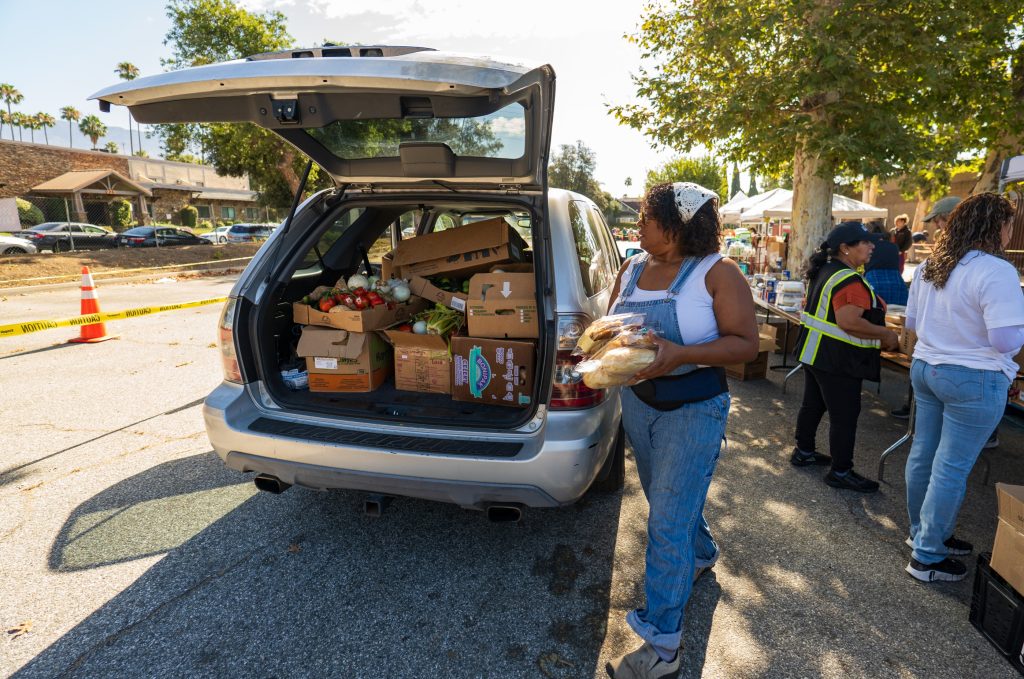
To help those in particularly vulnerable situations, volunteers began home deliveries to about 55 families. Ishell Linares-Soto, NDLON’s director of development, said she would like to expand the program to anyone who requests home deliveries but needs more resources to do so: more vehicles, trusted volunteers to pack boxes and deliver them, funding to cover gas and other transportation costs.
One idea, she said, would be to deliver food boxes to secure and confidential locations in key neighborhoods. Her network, for instance, is helping families organize to demand safe conditions in their Pasadena apartment building, which survived the fires but was impacted by smoke and soot. If the building became a site for food deliveries, it could help build the community’s cohesion, reach and power, she said.
In addition to the food pantry, NDLON is also organizing such action as legal assistance for families impacted by the raids and an “adopt a corner” program to provide volunteer monitors at Home Depot and other sites where day laborers gather to support them, Linares-Soto said. So far, community members have adopted about 40 corners, most of them in Los Angeles.
“We really think it will take all of this to keep our community safe,” she said.
One person who received food assistance from Mano a Mano had begun to volunteer at the job center after the Eaton fire and was recently crushed by news that her sister was detained by immigration agents. The volunteer has been fraught with anxiety since her sister, who is in poor health, is now considering self-deporting even though she has a legal work permit, Linares-Soto said. But she has been buoyed by the network’s services, including food, rent and legal assistance.
“I’m very grateful for all the help we’ve received,” the community member said through Linares-Soto. “I stand ready to fight for justice for my sister.”
Back at the Pasadena food distribution center, located in a parking lot off Lake Avenue, a line of vehicles snaked around the block and those on foot waited their turn with shopping bags, wagons, rolling carts and suitcases. The sounds of English, Spanish, Tagalog, Vietnamese and Chinese filled the air.
In recent days, organizers said, the number of people served has begun returning to pre-raid levels. Yet donations that flooded the center after the fires have declined; both volunteers and such items as beans, rice, canned tuna, milk and especially bottled water are badly needed, Linares-Soto said.

Miguel Bucio helped open stacks of boxes filled with produce from the L.A. Regional Food Bank as two dozen other volunteers scurried to fill boxes and lay out supplies on tables. He joined the Pasadena job center 17 years ago; the staff helped connect him to a community member looking for someone to help with heavy cleaning, a gig he held for more than three years. He went on to jobs as a painter and now works as a specialist in heating and cooling systems.
“I always come back to the job center just to help because the center’s helped me,” Bucio said. “I have to give back.”
Flori Schutzer started volunteering after she retired this year, continuing a life of service and support for such organizations as the L.A. Regional Food Bank and World Central Kitchen. She helps even as she undergoes treatment for cancer.
“I have my challenges, but I can still help,” she said. “I couldn’t not do something with everything going on in the world.”
As cars drove through the distribution line, Maria Martinez greeted drivers with a big smile and handed them cake, bread, cupcakes. She peered into one car, which carried a young boy strapped into a car seat in the back.
“You want bread? He looks hungry,” she said to his mother.
“He’s always hungry!” the mother replied.
Martinez volunteered in the past and came back with her daughter, Rosie, to serve after seeing heart-wrenching images on TV of the Eaton fire’s devastating impact on so many of her neighbors. She said she receives much more from the work than she gives: Expressions of gratitude. Thanks. Blessings.
“When someone tells me ‘Have a good day,’ it feels good,” she said.
–Teresa Watanabe