Unraveling Invisibility
Once unhoused himself, photographer and CCF Visual Artists Fellow Bumdog Torres uses his camera to show the humanity of those who live on the streets of Los Angeles.
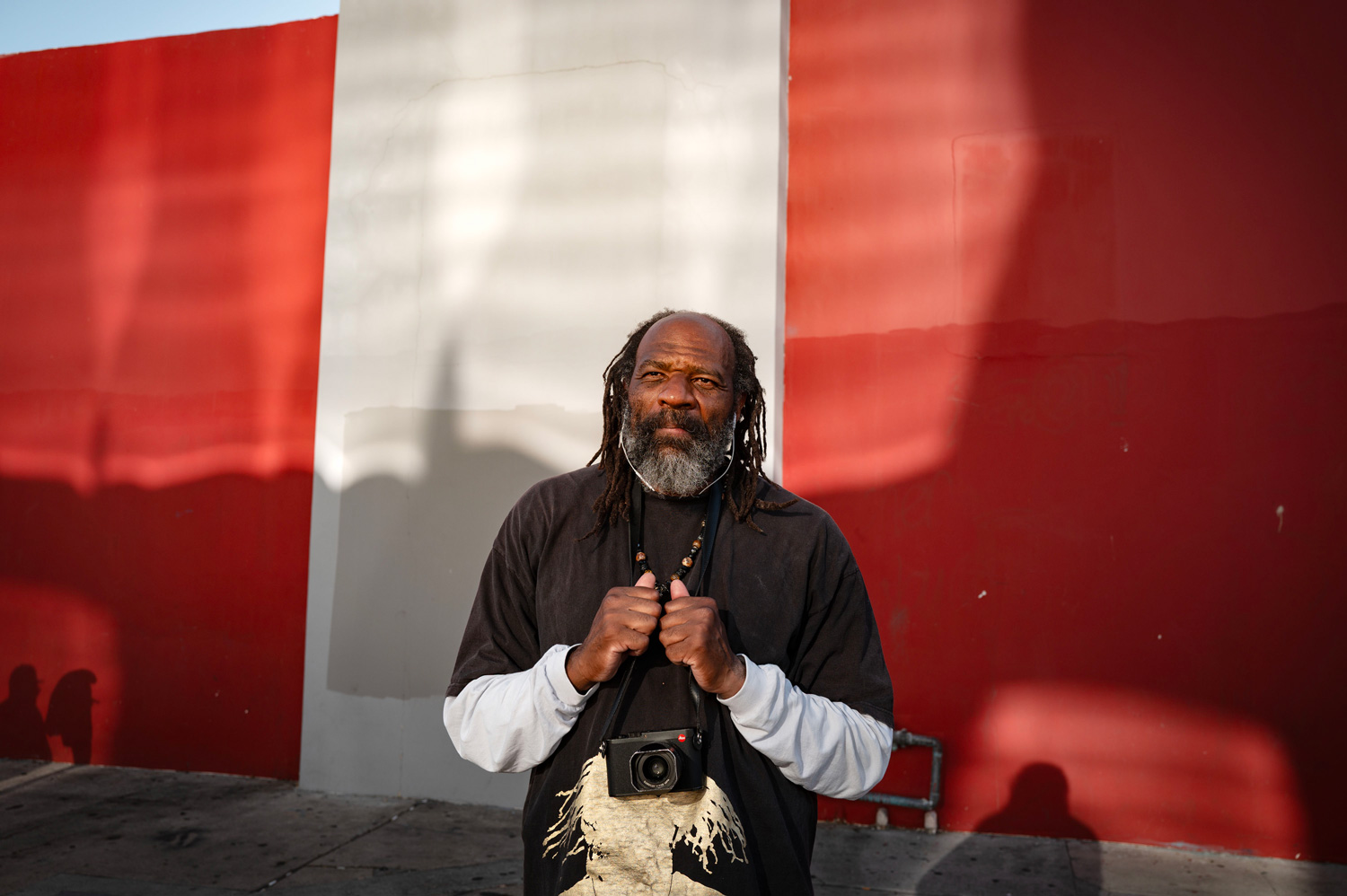
Photographer Bumdog Torres, supported by CCF ‘s Fellowship for Visual Artists, was unhoused when he started taking photos with a phone he bought on the street. Photo by Barbara Davidson.
He slowly ambles down the street, a striking figure at 6’4’’, dreads framing his burnished brown face, in the Fairfax and Hollywood districts of Los Angeles. Bumdog Torres has called himself a “career homeless bum” and “a complete nobody” and revels in that identity.
Except he’s not a nobody. He is one of the city’s most celebrated photographers of unhoused people – and creates his art with authenticity as someone who has lived on the streets himself.
As Bumdog pushes his shopping cart up McCadden Place off Melrose, a young man runs up to him. Xavier Baizar greets Bumdog, who promptly directs him into a pose with eyes serenely closed and fingertips touching, then snaps his photo with a high-end, handcrafted Leica Q1 and a Panasonic Lumix GH5.
Baizar beams, starstruck by the encounter. He had lived in the streets for a few weeks this year after leaving an abusive environment and had seen Bumdog around, assuming he was a “regular homeless man.” Then he saw a photo Bumdog had taken of people on the street that a friend posted on social media and was blown away. He vowed to flag him down and tell him how impressed he was by his art.
“He takes pictures of everybody and they are fantastic,” said Baizar, who now lives with relatives in Long Beach but returns most days to this neighborhood to attend nearby Los Angeles Film School and stay in touch with his “little family” of people on the streets. “He’s making outstanding portraits of people in the community. I had no clue but you can’t really judge people off their appearances.”
Bumdog’s photos capture faces wreathed in smiles, weathered with age and painted like clowns. Eyes pleading for help, bright with joy, dazed with drugs. Bodies sporting elaborate tattoos, colorfully dyed hair, decaying teeth and finely toned physiques. His photo books convey the names and backstories of many of those featured: Blind Man Anthony, Egg God, Krazy. He has photographed trans sex workers, military veterans, OGs fresh out of prison, a mother looking through the trash to find toys for her children.
The California Community Foundation has recognized Bumdog’s talents with a $40,000 grant as part of the nonprofit’s Fellowship for Visual Artists program. First established in 1988 with a $3 million grant from the Getty Foundation, the program provides unrestricted cash grants to artists, along with professional development opportunities to sustain and grow their creative practices. Bumdog was one of 11 artists selected for the 2024-25 class from more than 400 applicants.
Selected works from the artists will be on display at the Craft Contemporary arts museum in Los Angeles from May 31 through Sept. 7. Bumdog’s solo show, “The Positives of Negatives,” will take place June 7 from 6 to 9 p.m. at Post Mix Film Lab in Hollywood.
Álvaro D. Márquez, CCF program officer for arts and culture, said the foundation seeks to support artists with strong portfolios who may not have gotten the attention or breaks they deserve.
Bumdog’s work stood out for its beauty but also its perspective of someone who has lived the realities he is photographing, Márquez said. “Sometimes, the problem with stories of unhoused people is that they’re told from people who do not have the lived experience of the realities they are documenting. Bumdog is unique. He’s not an outsider parachuting in. These are his people, these are his friends and neighbors. They are not subjects.”
Bumdog himself says he creates his art for those neighbors and friends on the street, not for outsiders – although he is grateful for their support.
The CCF grant helped him out when he was just about broke and has allowed him to pay off $12,000 in debt – much of it for his printing costs. The funding also helped him buy a Mamiya RZ67 camera for medium format film and a 35 mm Leica R9. He was able to pay development costs for 100 rolls of film, and produce a new photo book, “Hollywood The Krazy Edition” that features his art along with writings about his life and those he photographed.
The fellowship program also provides artists with coaching, website development and other ways to develop their craft; for Bumdog, CCF helped buy 80 hours of darkroom time to develop his work for his solo show.
“It’s good to have your stuff shown and have some acknowledgement and maybe make some of the money that you got to blow on it. That’s not the reason why I do it,” says Bumdog, 56. “I don’t make what I make for other people, people outside of my world, to see it. When I show it, I show it to my friends.”
He had long wanted to have a photo show on Hollywood Boulevard so the homeless people he lived with could come see themselves reflected in his work. But since many of them have since scattered from the area and won’t be able to attend, the realization of that dream is “bittersweet,” he says. For many of those he photographed, including the unhoused trans people featured in his 2021 book, “Tangerine Land,” Bumdog’s work is the only pictures they have of themselves.
“Here in L.A County, homeless people live in a paradox,” Márquez says. “They’re hyper visible in the sense that we see their tents, we see them walking through the streets, but socially, politically, economically they’re invisible. And so Bumdog unravels that invisibility from a perspective you don’t often see.
“There’s a thousand other Bumdogs out there who are living in the margins, living in the shadows, have no attention, no support,” Márquez says. “And that’s why this fellowship matters. And that’s why it’s so important to support artists.”
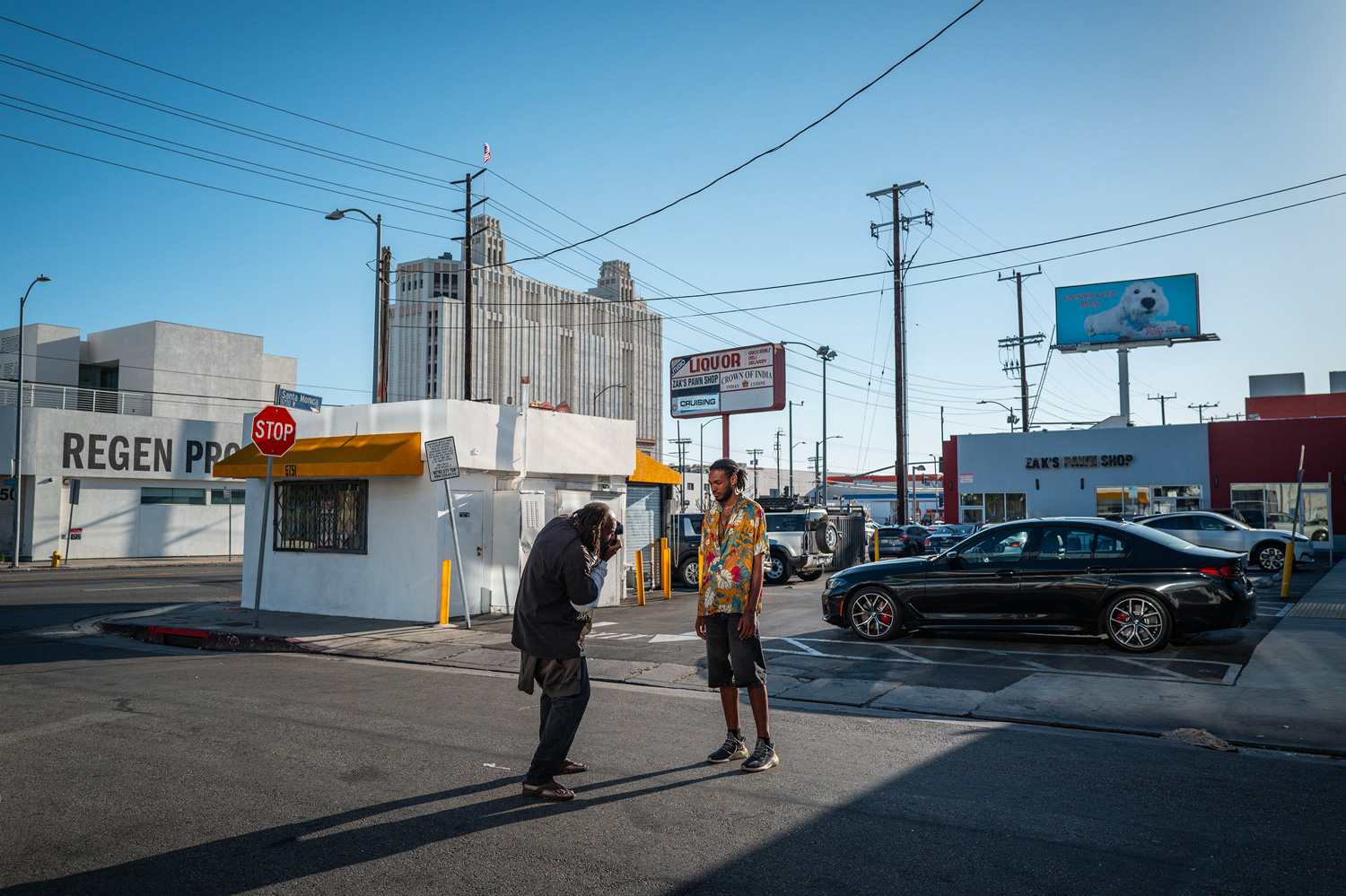
“It's good to have your stuff shown and have some acknowledgement,” Torres said. But “I don't make what I make for other people, people outside of my world, to see it. When I show it, I show it to my friends.” Photo by Barbara Davidson.
Bumdog grew up in the Crenshaw area of Los Angeles as the son of a single mother. When he was 14, he hurt his hip playing basketball and dropped out of school after 7th grade. He says he hated formal schooling – “it was like a jail” – but he fed his intense intellectual curiosity through his own reading and research.
As a teenager at home, he read books from his mother’s large collection and the public library on philosophy, literature, anthropology, metaphysics, psychology, political theory. He watched PBS courses on the quantum universe and plunged into research about the Napoleonic Age after seeing a Napoleon Bonaparte character turn up in an episode of “Bewitched,” the old fantasy sitcom about a suburban housewife witch. John Steinbeck opened his mind to literature as the first author he read who demonstrated that writing could reflect real life, not just fantasy.
In the early 1990s, he began pursuing his wanderlust and moved to San Francisco, where he first experienced living on the streets. He moved on to Las Vegas, London, Amsterdam, Paris, Spain, Morocco, Maui and other locales. In Thailand, he spent a few weeks in jail for overstaying his visa and in 2014 was deported back to Los Angeles.
He picked up the name Bumdog in 1997 when he landed in a Los Angeles jail for fighting and told his fellow inmates he didn’t drink, smoke or do drugs but bummed around the streets “because I’m a bum.” One of them laughed and called him a bumdog. The name stuck.
In 2014, he began exploring photography after he bought an iPhone 4S for $50 from a fellow street person who found it in the trash. He initially focused on portraits of himself reflected in mirrors he would find in the alleys and streets.
Three years later, a friend gave him an old Sony NEX-3, which shot better portraits and enabled him to start taking photos of people on the street. Not wanting to exploit them, he asks them for permission and typically offers $5 for the shot. As he uploaded his photos to Instagram and Facebook, his work began to draw attention; in 2018, an art gallery in Denver featured 15 of his photos in his first exhibition.
“And just like that I was a REAL photographer,” Bumdog wrote in his 2020 book, #FindTheBumdog” featuring his first images. “I had never called myself a photographer before, because I didn’t really care, and I was nowhere near as good as many professional photographers that I personally knew. But now I could say with all pretentiousness that I was a photographer.”
Motivated to develop his craft, he bought his first semi professional camera, a Panasonic G85, in 2019. The weak lens made him focus on shots with harsh and reflected light, which bathe many of those he photographs in striking compositions.
Living on the streets not only gave Bumdog an authentic connection with those he photographed. He says it also filled him with gratitude for the open sky, fresh air, birds and squirrels he shared his free life with. And knowing he had to wake up and move from the parking spot or doorway where he slept overnight gave him an “enforced discipline” that prevented him from giving in to lethargy and pushed him to get up to walk the streets, listen to music, greet the early morning workers and joggers – and hone his art.
In 2020, Bumdog decided to accept a placement in a Hollywood apartment secured by a housing agency worker named Catalina Hinojosa who contacted him through Instagram. The pandemic lockdown had shut down the coffee shops, libraries and other places Bumdog used to work and he was desperate to find an alternative. He remains ambivalent about his housed status.
“It feels terrible to be inside,” he says. “I’m like a feral animal. But it was kind of my destiny.”
Besides, he says, Hollywood has moved past the “golden age of homelessness.” Many of the camps where he took photos have been cleared away and those who lived there have scattered. He credits the city for making progress in housing people, although he says the root causes of homelessness – drug addiction and unaffordable housing – have not been resolved.
Many of the camps where he took photos have been cleared away and those who lived there have scattered. He credits the city for making progress in housing people, although he says the root causes of homelessness – drug addiction and unaffordable housing – have not been resolved.
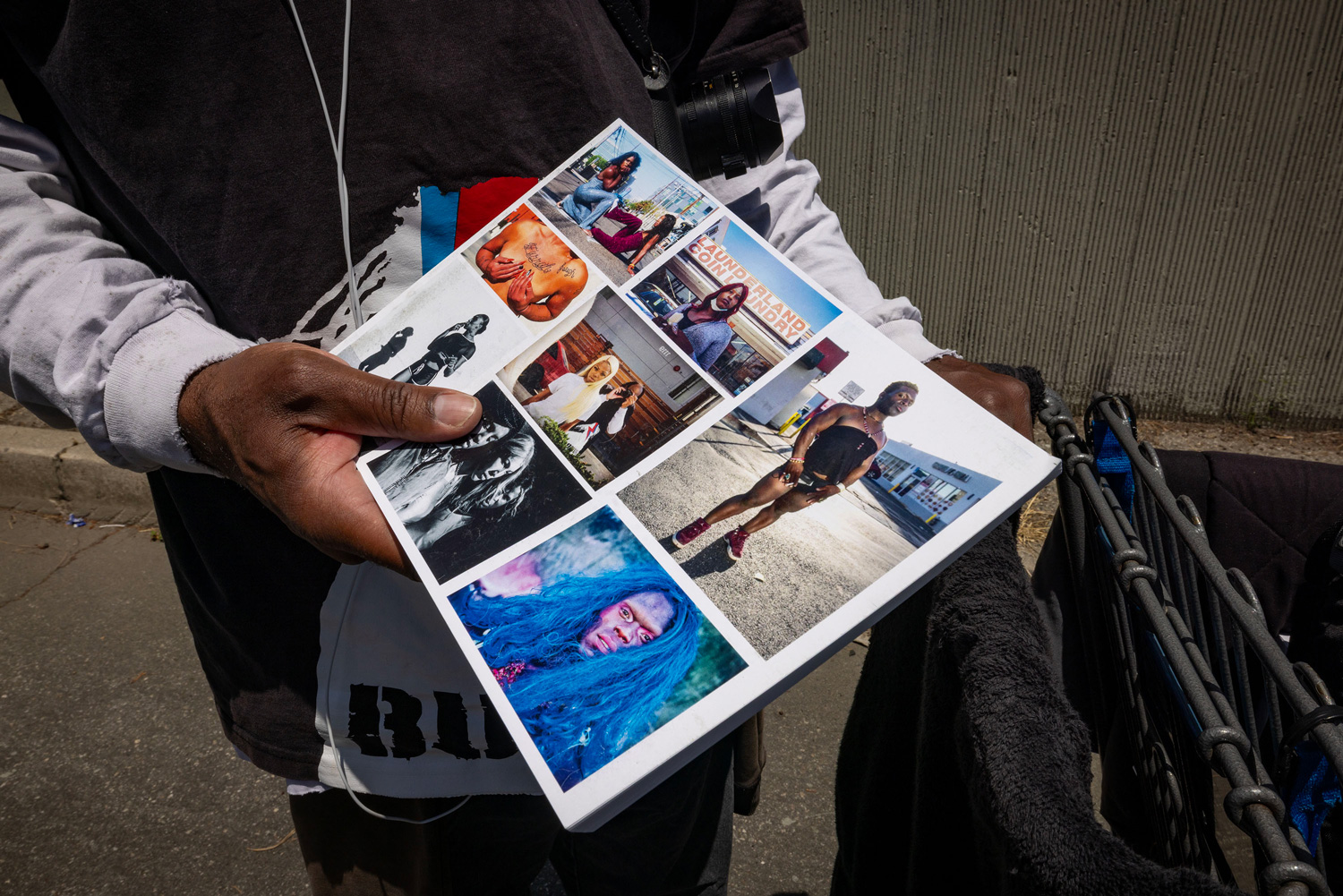
Over the years, Torres’ subjects have ranged from street life during the pandemic to the Orthodox Jewish community in the Fairfax neighborhood. Photo by Barbara Davidson.
But the artist still walks the streets with his shopping cart, covering an average seven miles a day, and takes pictures of people who catch his eye. During the afternoon he photographed Baizar, he also took shots of a man who introduced himself as the “Fairfax Monster” who has been incarcerated five times and an undocumented immigrant from the Dominican Republic.
Since 2020, Bumdog has produced seven photo books. Two more are set to debut at his solo show presenting images taken with his CCF-funded cameras: “Bumdog Mamiya” (with the title written in Japanese) and “Leica Bumdog: the #shootfilmgobroke Series.”
Over the years, his subjects have ranged from street life during the pandemic to the Orthodox Jewish community in the Fairfax neighborhood. He made a film based on his book, “Sketches of Nothing by a Complete Nobody,” and describes it as a film “considered unwatchable by the vast majority of people who have tried to get through it.” Nonetheless, he picked up skills he shares in free classes in the Bumdog School of Film.
Bumdog also writes voluminously, informed by his eclectic experiences and a range of thinkers, including Noam Chomsky, Walt Whitman, Shakespeare and Paramahansa Yogananda, a renowned Indian yogi and guru. Most recently, Bumdog has launched a zine with the first one titled, “Prayers to God from a Beggar in His Cell: The Spiritual Observations of a Lifelong Loser” and hopes to write a novel.
“I’m just a creative guy,” he says. “It doesn’t matter if it’s photography or teaching or writing. I just do it.”
— Teresa Watanabe