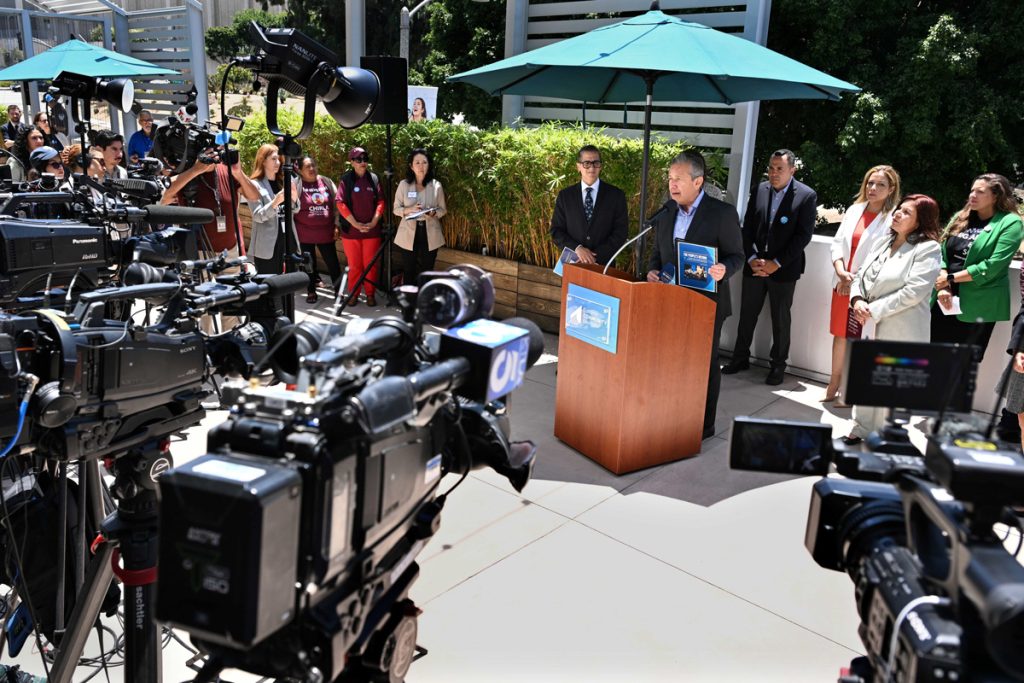
People’s Hearing on Immigration Enforcement Highlights Suffering – but Also Strength and Solidarity
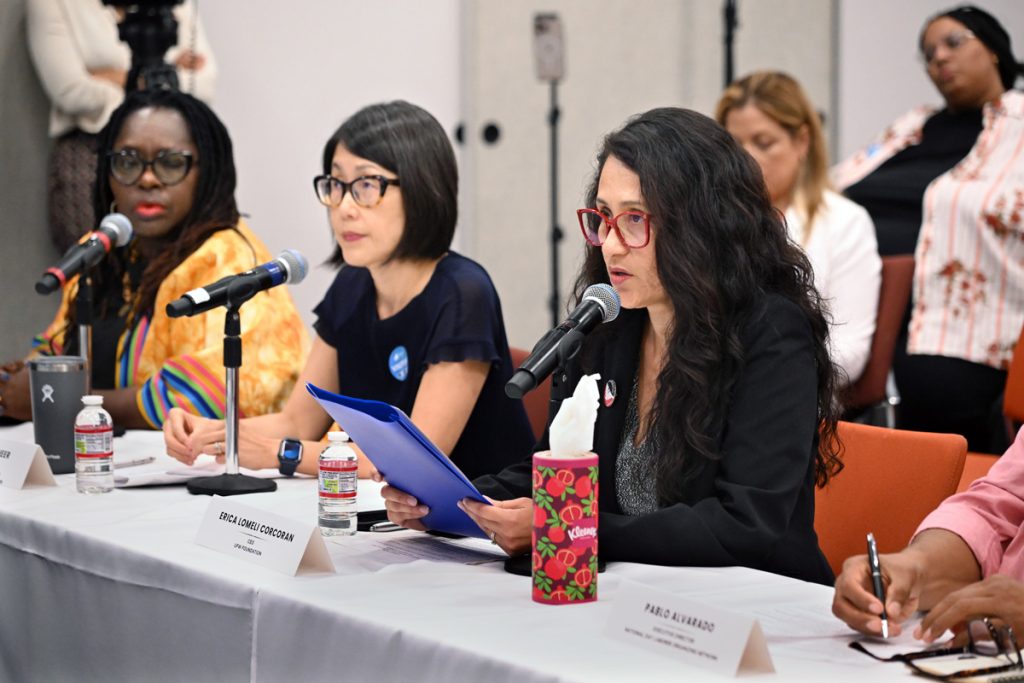
A year after federal immigration agents launched massive raids in Los Angeles, a daylong hearing documenting their impact drew shattering testimony of migrants brutalized, families ripped apart and entrepreneurs crushed amid pervasive anxiety and fear.
But the June 8 People’s Hearing on Immigration Enforcement, hosted at the California Community Foundation in downtown L.A., also highlighted resilience, courage and solidarity as community members described forming rapid response networks, raising support funds, leading legal challenges and organizing broad coalitions to demand their democratic rights.
“There are two stories here, the stories of the pain and suffering that still continues in L.A., but there’s also a story of tremendous resilience,” CCF President and CEO Miguel A. Santana said. “And so the story that we’re sharing to the rest of the country is not just the inhumanity of what we experienced, but also the way to push forward, the way to fight back, the way to insist that our story be told.”
The L.A. hearing was co-convened by civil rights and community organizations including CCF, Immigrant Defenders Law Center, Comunidades Indígenas en Liderazgo (CIELO), Coalition for Humane Immigrant Rights, the Hispanic Federation, Latino Victory Foundation, the Texas Civil Rights Project and the Miranda Family.
The hearing, following others in Minnesota and Chicago, was aimed at documenting the impact of large-scale immigration raids that began on June 6, 2025 through the testimony of those taken, their families, community activists, lawyers, faith leaders, scholars, entrepreneurs and others. The public record created will be used to demand accountability for the federal actions – and potentially help prompt an independent investigation into any racial profiling and civil rights abuses committed during the sweeps, said Rochelle Garza, chair of the U.S. Commission on Civil Rights, who co-presided over the hearing with Santana and Marty Castro, former commission chair.
During the five-hour hearing, testimony emerged of horrific treatment of migrants – giving voice to the human toll behind the data shared: 60,000 immigrants in detention nationwide. More than 3,500 calls for legal help to Immigrant Defenders. About 14,000 calls to CHIRLA’s rapid response hotline, with primary hotspots in Panorama City, North Hollywood and Pico Rivera. CHIRLA also documented that six in 10 of 1.438 families under its case management face food and housing insecurity and have not secured legal representation.
Julio, a migrant suffering from end-stage kidney failure, was taken from his front yard by immigration agents but was sent directly to the hospital after intake due to his frail health. There, he was chained to a hospital bed – with an immigration agent stationed outside his door – and suffered a stroke, which his family was not told about. Weeks later, he was finally sent home unconscious and died shortly afterwards while in his 40s, according to Melissa Shepard, Immigrant Defenders legal services director.
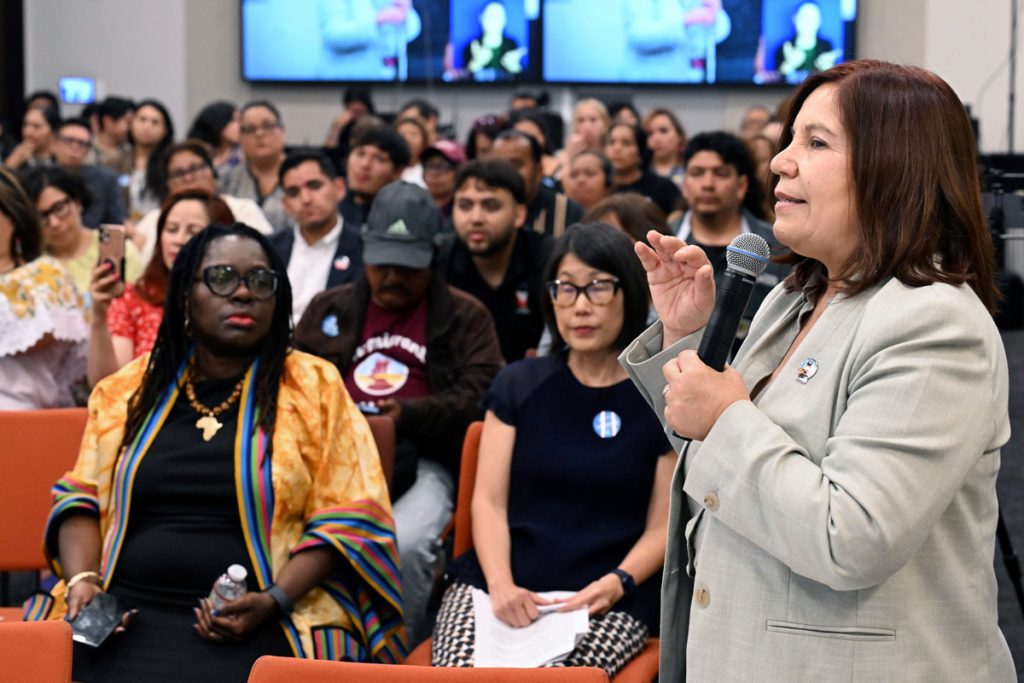
Christopher told the story of his uncle Daniel, a migrant with mental disabilities who was taken while picking up recycling items in his neighborhood. Christopher, an Ivy League college graduate who spent 50 hours a week researching immigration law on top of his full-time job to help his family, detailed the agonizing search for his uncle through the labyrinth of the immigration bureaucracy: 10 hours to locate him, 44 phone calls in one day until reaching someone who refused to help.
Eight days after his uncle was detained, his name disappeared from the online database. Christopher made the two-hour drive to the Adelanto detention facility, where he said the receptionist refused to give out any information. Then he spent hours searching in the high desert for his uncle, fearful that U.S. Immigration and Customs Enforcement officials had released a man with the cognitive capacity of a first-grader into unknown terrain. The family finally learned that ICE had deported him to Mexico. Fortunately, Christopher said, the uncle was located in a hospital there and finally came home in March, thanks to Immigrant Defenders’ legal work.
“What happened to my Uncle Daniel is systemic,” Christopher testified. “If this nightmare has taught me anything, it’s that the silence is exactly what this horrific system depends on to survive. And today, I commit on speaking out loud, proudly and without apology. I encourage everyone here to do the same, so this cruelty is never normalized and together our uproar will bring change.”
Some immigrants spoke about their experiences from behind a curtain, terrified of being targeted. One woman, who said she wanted to shed light on the underrecognized plight of Black migrants from Ghana, Haiti and elsewhere, described being “kidnapped in traffic” by ICE agents and placed in freezing rooms with no privacy, unsanitary conditions, inadequate medical care and spoiled food. She said detention staff frequently screamed at detainees with abusive language and pressured them to sign voluntary deportation documents.
Underscoring the ripple effect of one detention, the Rev. Jennifer Gutierrez testified about Jose, a car wash worker with a pathway to citizenship due to his U.S. citizen wife’s successful family petition. But he was picked up and detained for several months in Adelanto, suffering deteriorating health amid inadequate food and medical care. His son, a UC Riverside student, began struggling with school. His wife had to take a second job to make ends meet. The multiple pressures and stress have pushed the family to a breaking point, said Gutierrez, executive director of Clergy and Laity United for Economic Justice.
ICE and the Department of Homeland Security generally deny systemic abuse in immigration raids and detention facilities and say detainees are treated according to federal detention standards. They have acknowledged some problems uncovered by government watchdogs and other independent investigators.
But panelists said they are pushing for full accountability.
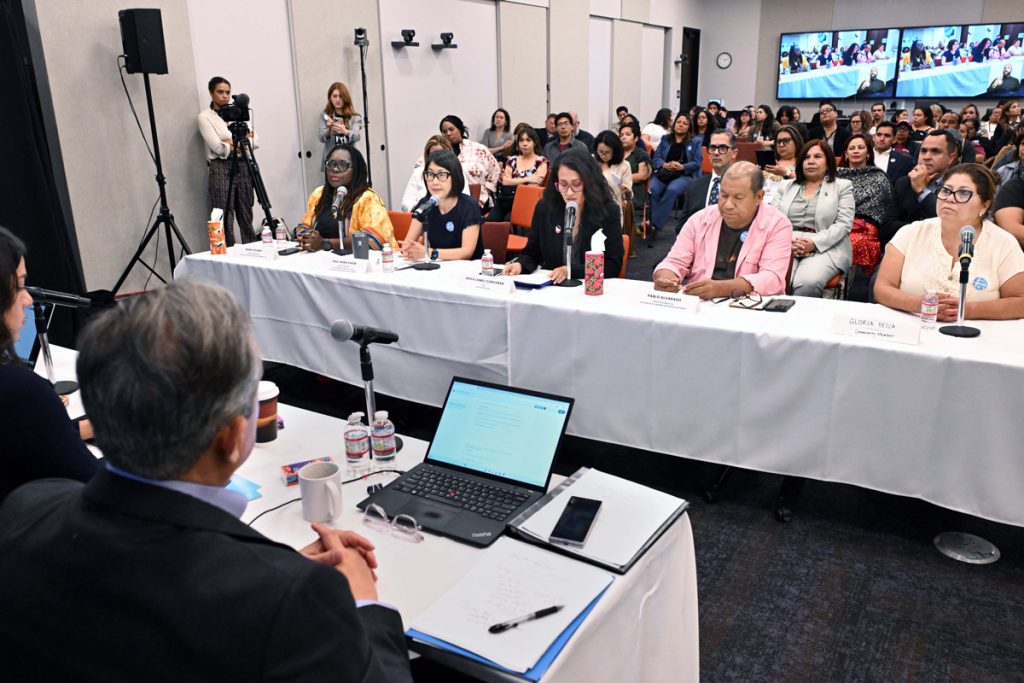
Lindsay Toczylowski, Immigrant Defenders president and CEO, and advocates with the ACLU of Southern California and other organizations, outlined their legal battles against what one called “rampant violations of the Constitution and their horrific cruelty towards people in ICE detention.” One lawsuit seeks an end to any racial profiling in immigration enforcement, while others take on “inhumane conditions” in ICE facilities and arrests without warrants.
Angelica Salas, CHIRLA executive director, said advocates are also lobbying for legislation that would restrict California state and local law enforcement from participating in certain federal operations that involve racial or identity profiling, including immigration enforcement. And they are taking to the streets in rallies for justice.
“Even in the face of fear, our people continue to resist, to organize and to demand that their humanity be recognized,” she said in earlier remarks at a news conference.
Los Angeles Mayor Karen Bass echoed that message. “The ICE raids tested us, but they also revealed who we are as a city,” she said at the news conference. “They caused fear and terror, but they did not break us. Our city stood unified…they strengthened our resolve. We are an immigrant city and we will always stand united in defending Angelenos.”
Organizations are aiding those affected in other ways as well. Gutierrez said CLUE has teamed up with Immigrant Defenders and others to raise $1.5 million to help 150 detainees secure their release by paying bonds – which are used to guarantee they will appear at their scheduled court hearings – ranging from $1,500 to $90,000. Other financial assistance highlighted at the hearing included a rental assistance program by CHIRLA and nearly $4 million raised and distributed to more than 6,000 families through CCF’s Los Angeles Neighbors Support Fund.
Rudy Espinoza, president and CEO of Inclusive Action for the City, described the nonprofit’s efforts to aid street vendors too fearful to work on the streets by training them to cater at events in more protected areas. Amada Armenta, an associate professor of urban planning who leads the UCLA Latino Policy and Politics Institute, shared research showing the severe economic fallout of the ICE raids on small business owners, with more than half of 84 interviewed reporting they had lost more than half of their income; nearly two-thirds had cut their hours or closed outright.
All told, more than 30 speakers testified on six different panels that explored sanctuary policies in Los Angeles, the impact on the workforce and the challenges of detention.
Santana told the audience that all Americans should be concerned about the troubling issues raised in the hearing because they don’t only affect immigrants. “This is about core American values, and the deterioration of those values to one community impacts everyone,” he said.
But, he added, the day’s testimony of resilience, courage and solidarity had deeply inspired him.
“As a Chicano from East L.A, I’ve got to say, I’ve never been prouder to be an Angeleno.”
– Teresa Watanabe