Eaton Fire Survivors Push for Stronger Laws to Help Clean Up Contaminated Homes
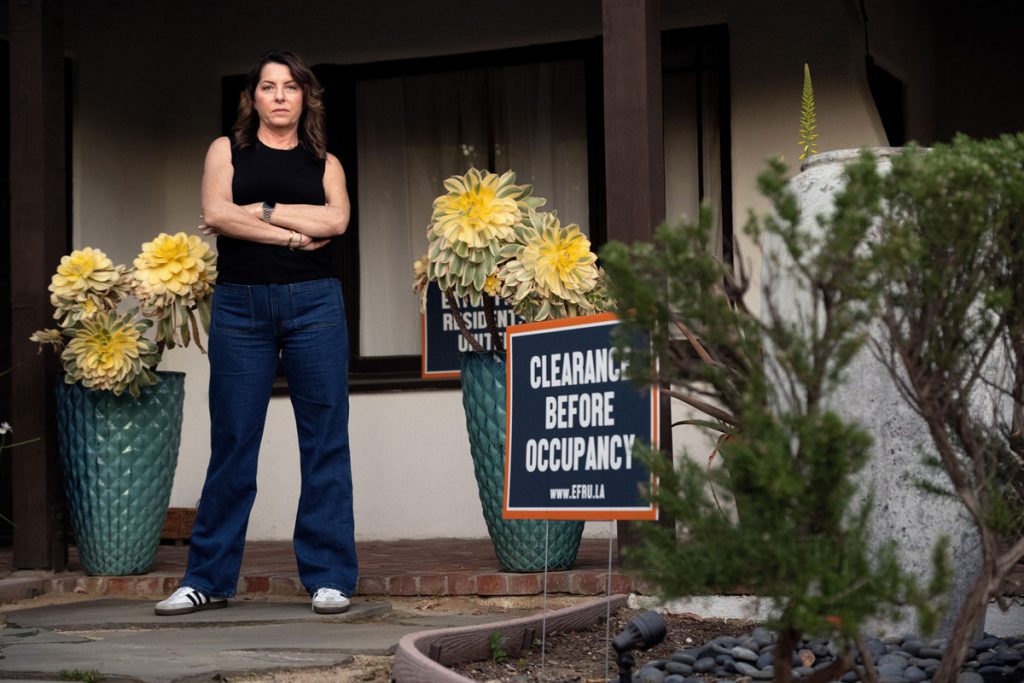
A few weeks after the Eaton Fire incinerated swaths of Altadena and Pasadena last year, Jane Lawton Potelle returned to Altadena to survey her home, which had escaped destruction. Within minutes, she knew something was wrong. Although she was wearing an N95 mask, her throat began to itch as particulates swirled in the air. She developed a terrible headache. Her chest felt tight, as if constricted by a heavy weight.
Her insurance firm’s field adjuster told her the debris contained just carbon from the burned bushes and trees and that she would be fine once it was cleaned up, she said. But Lawton Potelle hired an independent industrial hygienist, who found lead and other toxic heavy metals in her house. She was confused and uncertain what to do.
Thousands of other Eaton Fire survivors have faced similar challenges, and now they are rallying around proposed state legislation that would help them. AB 1642 would create the first statewide standards, based in science, for testing and removal of wildfire-caused contaminants in homes, workplaces, schools and in the surrounding soil.
The bill, authored by state Assemblymember John Harabedian (D-Pasadena), would specify what, where and when to test – including required samplings from HVAC systems, drywall and other building parts both before and after remediation. The state Department of Toxic Substances Control would be required to create standards by July 1, 2027.
The legislation is supported by the California Community Foundation and about 90 other organizations, including Eaton Fire Residents United, which helped spearhead the movement for action under the leadership of Lawton Potelle, the group’s executive director, and others.
The bill focuses on fires that occur in the “wildland urban interface (WUI),” or the transition zone between undeveloped wildland and human habitats. Such fires create particular dangers, because the ash, soot and char created from the burning of items often present where people live – plastics, lithium batteries, lead paint, asbestos-contaminated insulation, rubber tires – commonly release a toxic brew of chemicals known to cause cancer and other diseases.
“What’s at stake is the health of our families and ourselves,” said Lawton Potelle, whose home is still contaminated and unremediated because of long-running disagreements with her insurer over what testing will be covered. “For some folks, their homes are highly toxic; as soon as they spend a few minutes there, they start feeling sick even after remediation.”
Shayna Englin, CCF vice president of policy and advocacy, said the lack of clear, reliable and enforceable standards for home and environmental testing and remediation was a “critical gap” for community members trying to return home.
“CCF is committed to walking the road of recovery and rebuilding side-by-side with Eaton and Palisades fire survivors until everyone can go home,” Englin said. “That’s why we proudly support Assemblymember Harabedian’s AB 1642 and the bold leadership of Eaton Fire Residents United and other survivors advocating for this bill.”
After independent testing found heavy metals in Lawton Potelle’s home last March, an industrial hygienist contracted by the insurance company found asbestos in one room in June. Then the insurer sent another tester in September – who found no discernable contaminants of any kind, Lawton Potelle said. As the process drags on, funds for living expenses provided by her insurer are set to run out in June.
Dawn Fanning, another EFRU member, said she still gets headaches when she returns to her Pasadena home more than a year after the Eaton Fire ignited on Jan. 7, 2025. She, Lawton Potelle and other group members began encouraging neighbors to get their homes tested; hundreds did. The results showed that even after remediation, 96% of homes still contained lead and 36%, asbestos.
The group has launched a website, which shows contamination data, mapping, information about testing, insurance, remediation and other resources. Among those joining the effort is Francois Tissot, a fire survivor and California Institute of Technology geochemistry professor who has studied the contamination firsthand and raised alarms about the threat to human health.
“The risk is greatest for children, whose developing bodies absorb lead in place of calcium, causing irreversible cognitive damage,” he said.
The bill is opposed by the National Association of Mutual Insurance Companies and three other insurers. They said the legislation presumes toxic conditions in virtually all affected buildings without evidence of exposure, mandates testing in areas without scientific consensus that the methods are appropriate or necessary, ignores chemical levels already present even in unaffected homes and will drive up costs for insurers and policyholders, ultimately impeding recovery.
But the Assembly Committee on Environmental Safety and Toxic Materials passed the legislation on March 10. The committee analysis concluded that:
“The science on toxic chemicals after WUI fires and urban conflagrations is complex and emerging, and yet residents impacted by these events urgently need science-based standards to ensure that they can safely return to their homes and their communities. This is a cutting-edge issue with major human health implications, underscoring the importance of having chemical hazard and scientific experts play a role in developing these standards. AB 1642 aims to fill this gap….”
Harabedian said the committee approval showed “progress and hope.”
“It proves that when we listen to people’s real experiences and follow the science, we can create solutions that protect families and communities,” he said. “This is only the first step, but it’s an important one.”
The legislation will be heard next by the Assembly Appropriations Committee. A hearing date has not yet been set.
– Teresa Watanabe