At a Skid Row Clinic, Patients Fear Immigration Raids and Losing Their Coverage in Budget Cuts

Dentist Mekmanee Lallana treats a patient at the Los Angeles Christian Health Centers. Photos by Barbara Davidson
Celia has decaying teeth, backaches, prediabetes and varicose veins — health issues that could take a worrisome turn for the worse as she lives in the shadows as an undocumented immigrant on Skid Row in downtown Los Angeles.
But she also has help: Harry Le and his street team of care workers from the Los Angeles Christian Health Centers, who keep watch over her and others on Skid Row with check-ups, medications, treatments and referrals.
During a recent team visit to Celia’s piece of the street, marked by a blue tent and plastic tarps, she told Le her “legs hurt bad.” He promised to get her compression socks. He said her blood sugar levels looked better but she needed an ultrasound to check for hepatitis C. When she told him she skipped her dental appointment at the LACHC Joshua House Clinic a half-block away because she saw U.S. Immigration and Customs Enforcement agents in the area and fled for the day, Le reassured her.
“If you ever need a safe space, just run to the clinic,” Le, a physician’s assistant, told her.
Celia, 63, said the team’s care – which began earlier this year when they treated her partner’s dog bite – has made a big difference in her life. “They come and look in on us to see how we’re doing,” she said. “We need somebody like them. I love them.”
But such care for undocumented immigrants and low-income Californians could be jeopardized by state and federal proposals to reduce access to health insurance. The proposals have set off widespread alarm by care providers – and many of those they serve.
“It will be terrible,” Celia said. “I need my health. I need better living.”
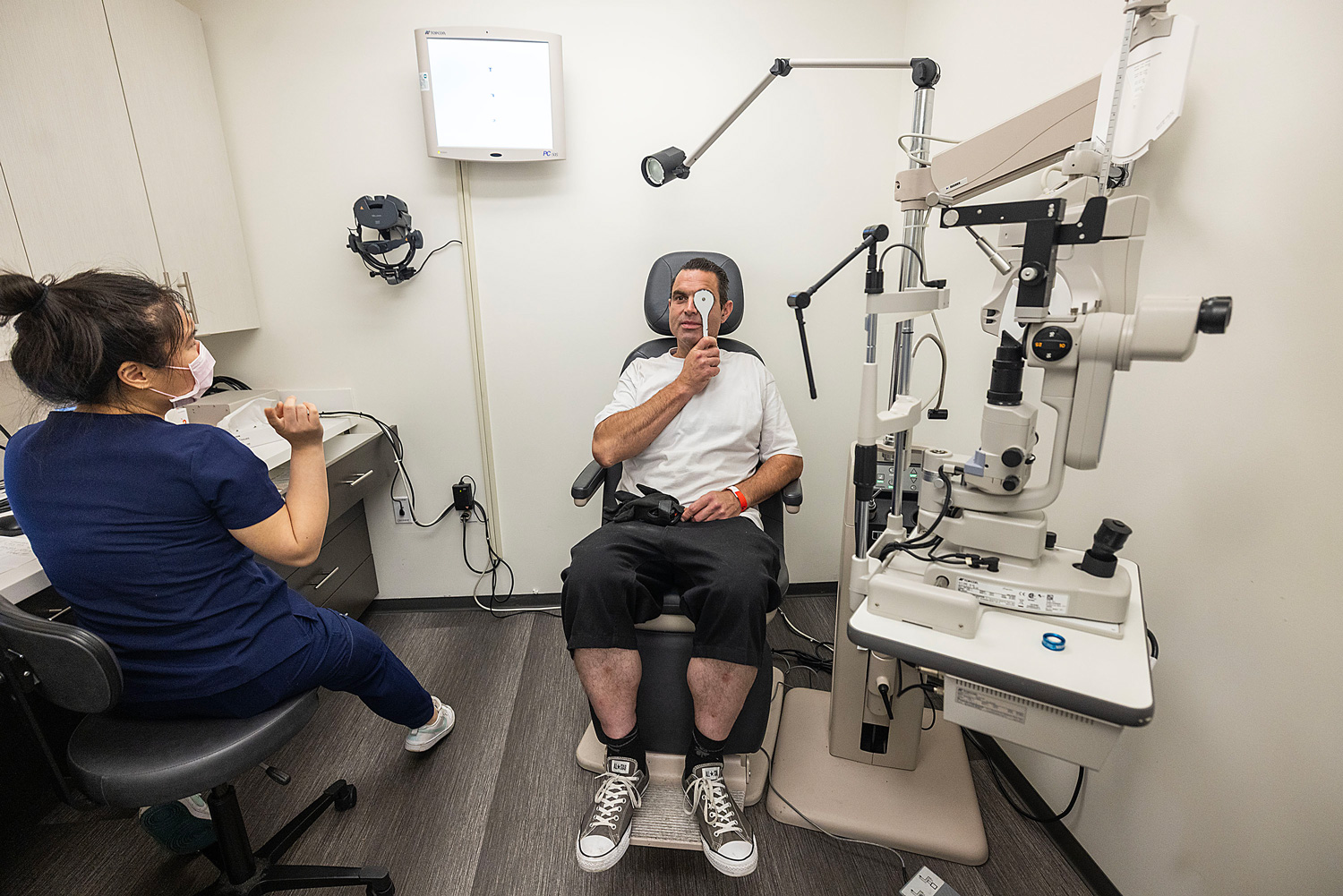
Michelle Huang gives patient Gilbert Jones an eye exam at the Los Angeles Christian Health Centers.
Thanks to the decision last year by Gov. Gavin Newsom and the Legislature to extend health insurance to all undocumented immigrants, Celia is in the process of applying for the first time to Medi-Cal, the state’s version of the federal Medicaid program for low-income people.
But Newsom, grappling with a multibillion-dollar state budget deficit, has proposed freezing new enrollment in Medi-Cal of undocumented immigrants ages 19 and older. He also has proposed eliminating dental care coverage and imposing a $100 monthly copay.
The Legislature’s budget proposal includes the enrollment freeze but counter proposed lowering the monthly copay to $30 for people ages 19-59 and delaying the elimination of dental benefits until July 2027. Budget negotiations are ongoing.
In addition, the Trump administration is proposing $600 billion in cuts to the federal Medicaid program, work or volunteer service requirements for able-bodied adults without dependents and recertification of eligibility twice annually rather than once.
The California Community Foundation has joined with partners in philanthropy, health care, labor and other sectors to bring attention to the potential harm to Californians should undocumented residents be denied Medi-Cal health coverage. Californians for Prosperity and Affordability, a CCF initiative, released a poll showing 63% of California voters support healthcare access for undocumented immigrants.
Bettina Lewis, LACHC president and CEO, said the proposals could devastate her organization’s ability to provide health care to society’s most vulnerable residents – those on Skid Row, living on perilously low incomes, bereft of homes, often lacking legal status and struggling with medical issues and mental health trauma.
Although the center does not collect immigration information, Lewis estimated that about 35% of the 11,000 people they annually serve are undocumented. But 90% of their patients now have health insurance, thanks to greater access granted under the 2014 Affordable Care Act and last year’s state expansion of Medi-Cal benefits to all Californians regardless of immigration status. Before 2014, she said, 80% lacked health insurance.
But the new state and federal proposals could place as many as 3,000 of her patients at risk of losing health care benefits. Even if the state freezes only new enrollment, Lewis said some immigrants currently with benefits may be too fearful to re-enroll and potentially become a target of ICE sweeps and raids. That fear is bound to deepen amid news reports that the Trump administration has provided sensitive information of Medicaid recipients, including their immigration status, to the Department of Homeland Security. So far, Lewis said, about 10% of LACHC clients have not re-enrolled.
In addition, the $100 monthly co-pay, along with proposed federal work requirements and twice-annual verifications of eligibility, could lead to major setbacks in health care access, Lewis and other clinic workers said.
“It’s a step back in health equity when we have the undocumented community losing benefits, coupled with concern that many patients are too afraid to re-enroll,” Lewis said. “They are choosing to go uninsured in fear of being deported or put on the immigration radar.”
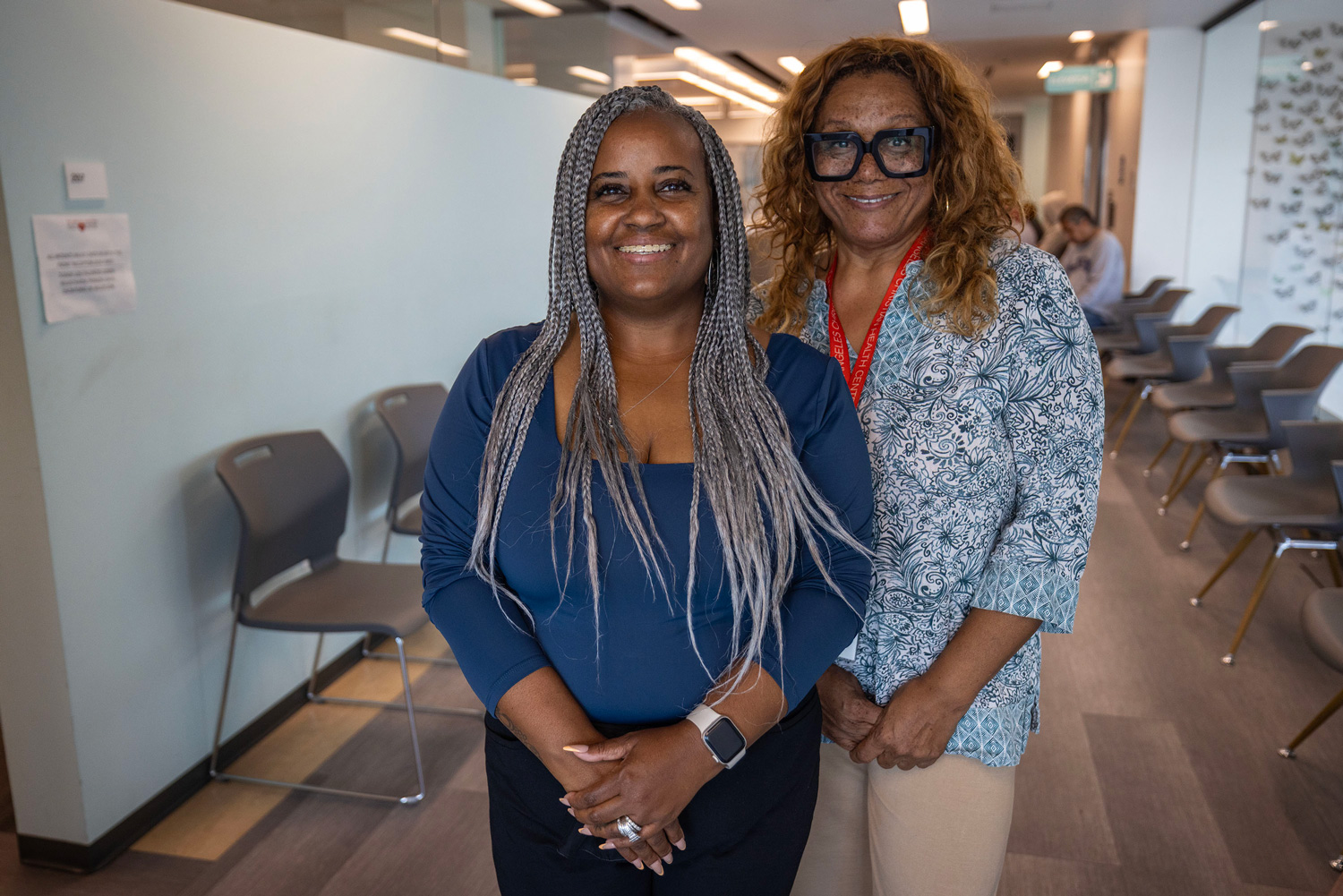
Bettina Lewis, President and CEO (L) and Renee Smith (R) , director of advancement at the Los Angeles Christian Health Centers.
Lewis said LACHC will stay true to its mission regardless of state or federal reductions in health care funding. But it could put the organization in a financial hole, requiring additional fundraising of $2.5 million to $2.8 million annually. The center receives about $17 million in state and federal funding and raises about $300,000 from individual donors each year.
“First and foremost, we’re still going to serve the undocumented population,” Lewis said. “We’re not going to turn any patient away. We’re going to serve them and take the hit.”
The center has served residents in the Skid Row area since 1990, when a nurse named Annie Calvo started it under the Los Angeles Mission to serve patients in the drug and alcohol rehabilitation program during the height of the AIDS crisis. In 2004, LACHC went independent and broadened its services to all people, with a mission to particularly serve unhoused residents of Skid Row. The organization expanded to several centers but has since shut most of them down, with the Joshua House on 7th and Wall Sts. its flagship clinic.
In 2021, the clinic relocated to a new three-story building offering medical, dental, optometry and comprehensive case management services with state-of-the-art equipment. The facility is spotlessly clean and bathed in intentionally soothing colors of soft greys and greens. A supply room is filled with clothes, hygiene items, instant ramen and snacks, even bags of pet food, which outreach specialist Angela Taylor distributes at table events and other outings.
“Just because we serve in Skid Row doesn’t mean the facility has to look like Skid Row,” Lewis said.
In the optometry center, two patients praised the services. Brian Walker lived on Skid Row for years after his mother was killed in a car accident in 2008 and the family lost their home. Even after the L.A. Mission helped him secure housing in the Crenshaw area of L.A., he still takes the bus to Joshua House for what he said is excellent health care. He said the staff provides him annual physical exams, dental checks, eye exams, glasses and medications for his high blood pressure and cholesterol.
“They keep me healthy,” he said. “I don’t know what would happen if they weren’t here.”
Matthew Jones also lived on Skid Row after his father died in 2019 and he was no longer allowed to live in the family home. He ran into trouble and was incarcerated; after being paroled he said he had nowhere to go and ended up on the streets. He found his way to LACHC, where he receives not only medical, dental and optometry services but also counseling for the years of trauma he’s experienced.
What would happen if state and federal funding for such care were cut?
“It would be catastrophic, bigtime,” Jones said. “A lot of people wouldn’t make it in the worst way.”
In the dental section, clinic staff echoed those warnings. Roy Koh, the clinic’s lead dentist, said many patients have not seen a dentist in years and come in with dire needs, including rotting teeth and advanced gum disease. That, in turn, can potentially lead to diabetes, heart problems, even foot and toe amputations, he said.
“It’s really full body, all interrelated,” Koh said. “If funding is cut, it will greatly affect access to care and without access where will they go when they have a huge abscess?”
Back on the street, Celia sat on a crate while Yajayra Rodriguez, a medical assistant, took her temperature – normal – and blood pressure, which was slightly elevated. The street team goes out every weekday but Fridays to offer health care – taking vitals, treating wounds and providing medications. Sometimes, people get burns from the fires they start on the street to keep warm. Sometimes, their wounds get infected, draw maggots and flies and need hospital care if the infections seem headed toward life-endangering sepsis. STDs are common.
Team members also help with enrollment in Medi-Cal and connections to housing and other resources. But most people are wary and decline services, Le said, which is why building trusted relationships is a team priority.
One successful case is Gonzalo, an undocumented immigrant who happened upon the team as they walked the streets.
“Hola! Buenos tardes!” Rodriguez called out.
Gonzalo needs an X-ray or MRI to pinpoint the cause of neck pain that is radiating into his shoulder and arm, Le said. But he hasn’t been able to apply for Medi-Cal because he has no ID from either the U.S. or his native country of Mexico.
For now, he told Rodriguez, his pain has improved, thanks to medications and muscle rub Le brought him.
“They’ve been very helpful, checking up on my health,” Gonzalo said. “With what’s going on with immigration, a lot of people are afraid to give information but I understand they have nothing to do with ICE and am grateful they’re able to care for me.”
–Teresa Watanabe
CCF fundholders can donate to Los Angeles Christian Health Centers through DonorConnect, their relationship manager or by emailing donorrelations@calfund.org. Others may contribute to the organization directly.